
Review mining has an obvious flaw that most vendors in the space prefer not to discuss: the people who write reviews are not your customers, they are the subset of your customers who felt strongly enough to type. Revuze addresses that more seriously than most, without solving it entirely.
The source mix is the real feature
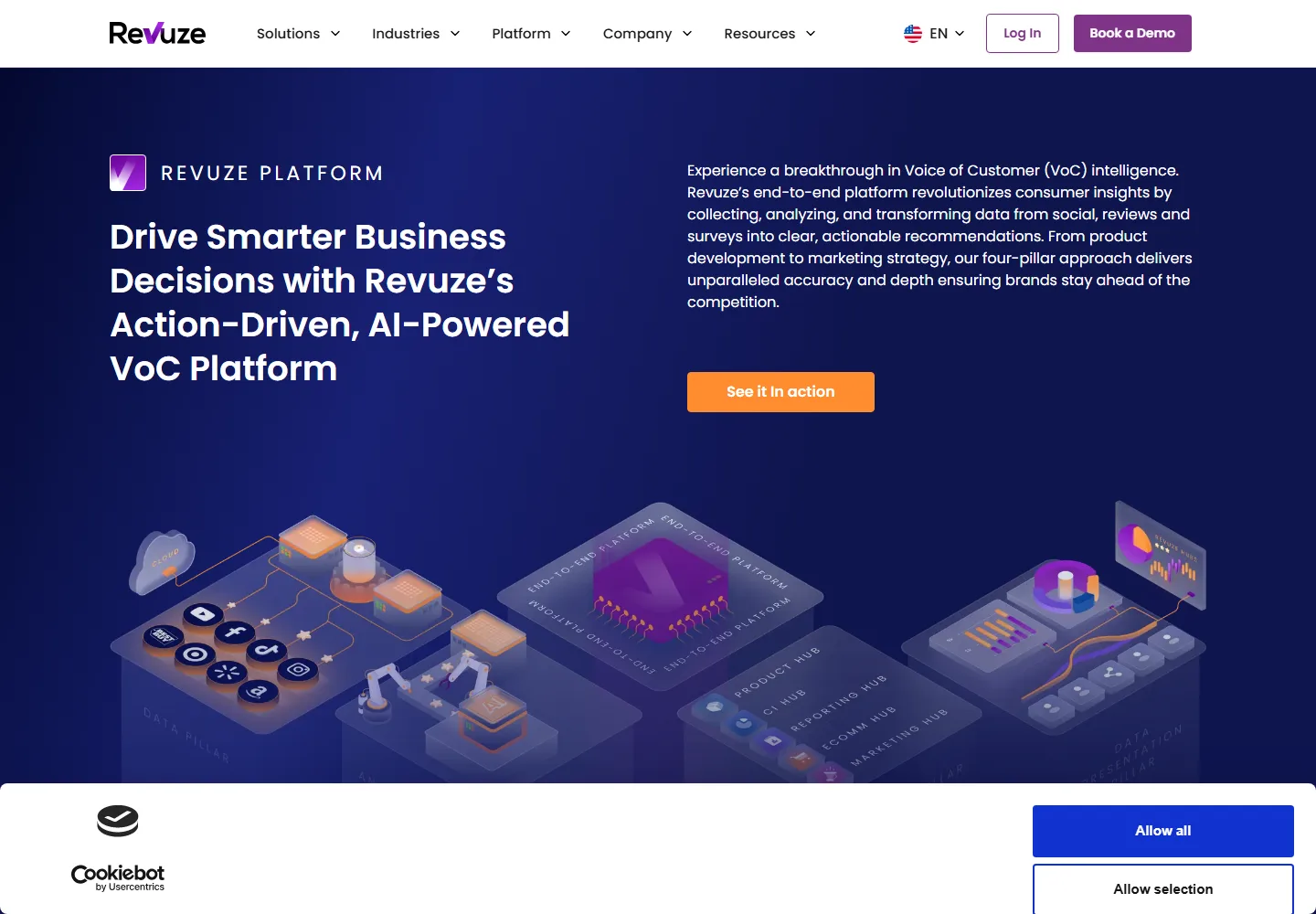
Reviews, social conversations, surveys, CSAT responses, forums, video, retail signals and customer care tickets.
Two of those matter disproportionately. Care tickets and survey responses come from people who did not choose to broadcast an opinion. A customer who contacts support about a confusing setup process is telling you something that never appears in a public review, and a survey respondent is answering a question you asked rather than volunteering a grievance.
Adding those sources genuinely widens the picture. It does not make it representative, because ticket volume over-represents people with problems and survey response has its own biases, but it moves the evidence away from pure self-selection, and that is the most useful thing a platform in this category can do.
Category-level competitor comparison is the second sensible design decision. Knowing that 30 percent of your reviews mention battery life means little until you know the category average is 12 percent.
The claim that needs defining
The site leads with proprietary LLMs ensuring maximum data quality with 90 percent or better accuracy.
Accuracy at what? Sentiment classification, topic extraction, spam filtering, attribute detection? Against what ground truth, since measuring accuracy requires a human-labelled set to compare against? On what sample, and in which languages, since performance on English reviews and on Portuguese ones will differ?
These are not gotcha questions. Any team that has actually measured accuracy can answer them immediately, and the answer is informative either way. A 90 percent figure on language detection is unremarkable. A 90 percent figure on sentiment classification of sarcastic product reviews would be genuinely impressive and worth paying for.
The same applies to proprietary LLMs as a differentiator. Every vendor says this now, and without a published evaluation it conveys nothing about whether the models are better than a general one at this specific task.
Where the method works and where it does not
The customer list is instructive: L’Oréal, Bosch, Logitech, Haleon, P&G. Consumer goods, high review volume, many SKUs, direct competitors with comparable products.
That is where this method has enough data to find patterns. A B2B software company with forty reviews across three competitors will not get pattern analysis, it will get a summary of forty reviews, which anyone can read in an afternoon.
Before evaluating, count your actual review and ticket volume per product. That number, not the feature list, determines whether the platform can tell you something you did not already know.