Most credit-based generators ask you to buy first and work out the exchange rate later. Imaginode does the opposite, and that single decision is what makes it worth a marketer’s attention.
What it gets right
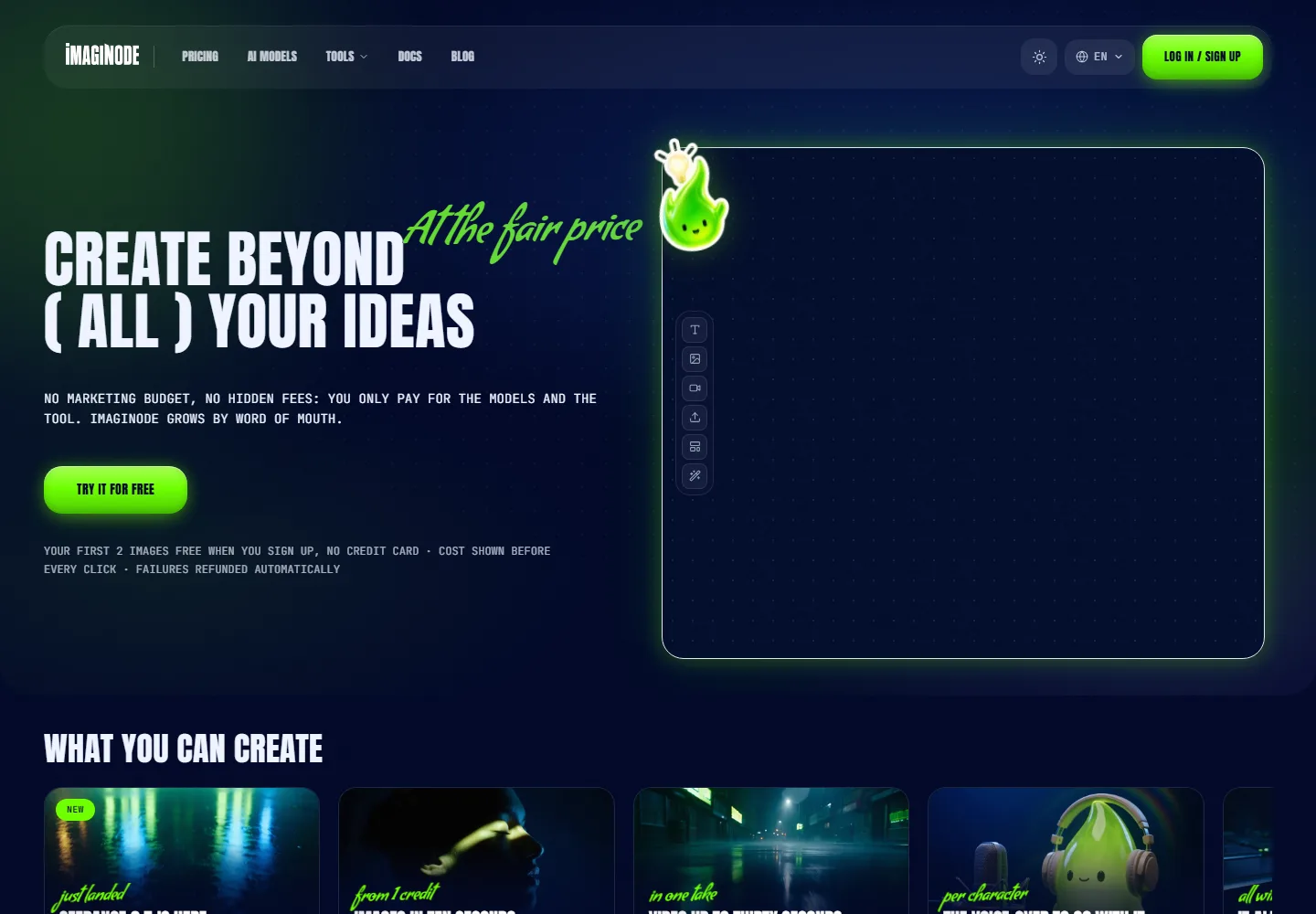
The per-generation cost of all 74 models is published on a public page that needs no login. The interface states the exact cost before each click. The API returns the cost and your new balance at launch. One credit is stated as roughly 0.012 USD.
The practical effect is that a campaign can be priced before it is run. Twenty product images on Nano Banana at 6 credits is 120 credits, near enough 1.44 USD. Four five second Kling clips at 26 is 104. You can build that estimate from published numbers without a trial, a sales call or a support ticket. In a category where the credit cost of a video is routinely absent from the pricing page, this is the exception rather than the standard.
The range behind one balance is the other half of the argument. Flux, Seedream, Nano Banana, Recraft and Topaz for images. Kling, Veo, Seedance and Wan for video. ElevenLabs and MiniMax for voice. Subscribing to those separately costs considerably more than 17 USD a month, and most marketing teams would use each of them occasionally rather than heavily.
The number the pricing page does not give you
Here is the part that matters most, and it is a distinction the vendor’s own framing blurs.
Every plan advertises that a failed generation is refunded. The terms define that narrowly. A re-credit is triggered only by a technical failure on the AI provider’s side where no content comes back. A generation that completes is charged, and the terms spend three paragraphs listing what a completed generation may look like: a character that does not perform the requested action, an element missing or replaced, embedded text that is illegible, artifacts on faces, hands or objects, motion, colour or framing that differs from what you asked for. These are named as inherent limitations rather than defects, and the terms state that a technically completed generation is due regardless of any judgment of the result.
That position is defensible, and stating it this plainly is more honest than most vendors manage. But it changes what the published price means. The cost per click is fixed and knowable. The cost per asset you would actually publish is that number multiplied by your hit rate, and nothing published can tell you what your hit rate will be.
The gap widens at the top of the range. An eight second Veo 3.1 Fast clip costs 144 credits. The 900 credit Starter plan therefore holds six of them. If two attempts in three land, that plan produces two usable clips a month, not six. Budget from attempts, not from the plan’s headline seconds of video.
Rights are the gap
For a marketer, this is the section that decides whether the tool can carry production work.
Nothing published grants you ownership of your output or the right to use it commercially. The terms of sale cover prices, credits, refunds, liability and prohibited content. On output they say only that users are solely responsible for the content they generate and the use they make of it, which allocates risk to you without granting you anything. There is no separate AI terms page, and the privacy policy addresses data rather than rights.
Compare the position elsewhere. Canva states that you own your output and makes no copyright claim over it. Fashion Diffusion states that generated content is owned by the user. Both settle the question a brand’s legal review will ask. Imaginode leaves it open.
Two related absences follow the same pattern. No clause addresses uploading photographs of identifiable people, although the product markets talking avatar and UGC video tooling that takes uploaded faces. And the privacy policy, which lists processors carefully and names Vercel AI Gateway as the route your prompts and reference media travel, does not state whether any of that is used to train models.
None of this makes the tool unusable. For concepts, moodboards, internal decks and social tests, it is beside the point. For a national campaign, a product page or anything printed at volume, get an answer in writing before the first asset ships. The contact address is a Gmail one, which tells you something about the scale of the operation you are asking.
Buy it the right way
Two structural details are worth acting on rather than reading past.
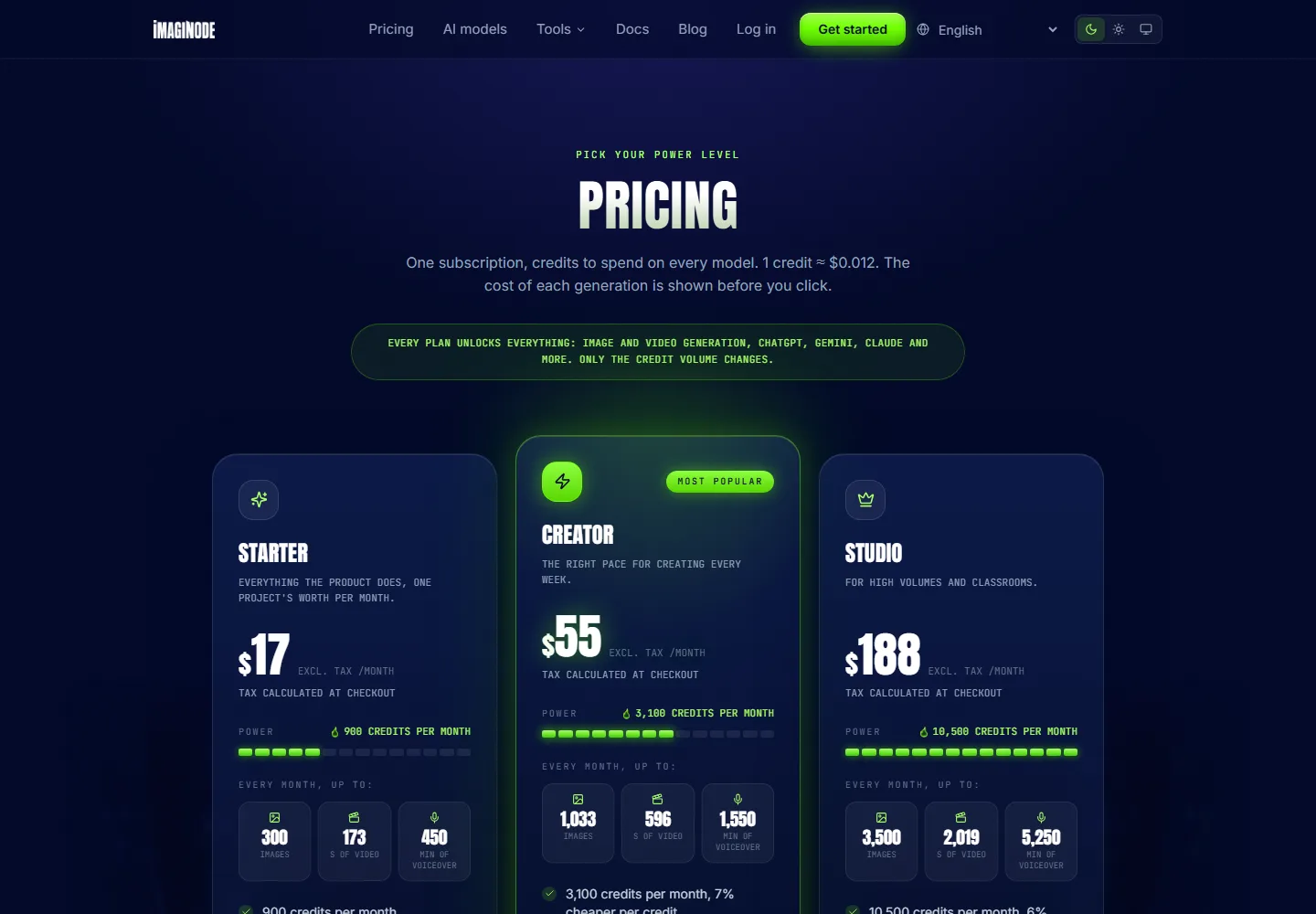
Subscription credits reset at renewal and are always spent before top-up credits, which never expire while the account is active. If your work comes in bursts around a few campaigns a year, top-ups are the cheaper structure and a subscription quietly wastes the months you are busy elsewhere. If you generate every week, the subscription unit rate is better, with Creator and Studio described as 7 and 6 percent cheaper per credit.
The second is currency, and it is worth more than a passing glance. The English site prices the three plans at 17, 55 and 188 USD. The French site prices the same three plans at 13, 42 and 145 euros. Both figures exclude tax, and the terms state that prices are expressed in euros. Those are not equivalent amounts at any recent rate, and the gap is consistent across all three tiers rather than a rounding artifact. The operator is French, payment runs through Stripe, and tax is applied at checkout by territory. Check the first invoice against what your card was actually charged.
Where it fits
This is a tool for one person who produces a lot of visual material and wants to see the meter. On that brief it is well made and priced with unusual candour, and the API and MCP server extend it to automated production without changing the economics.
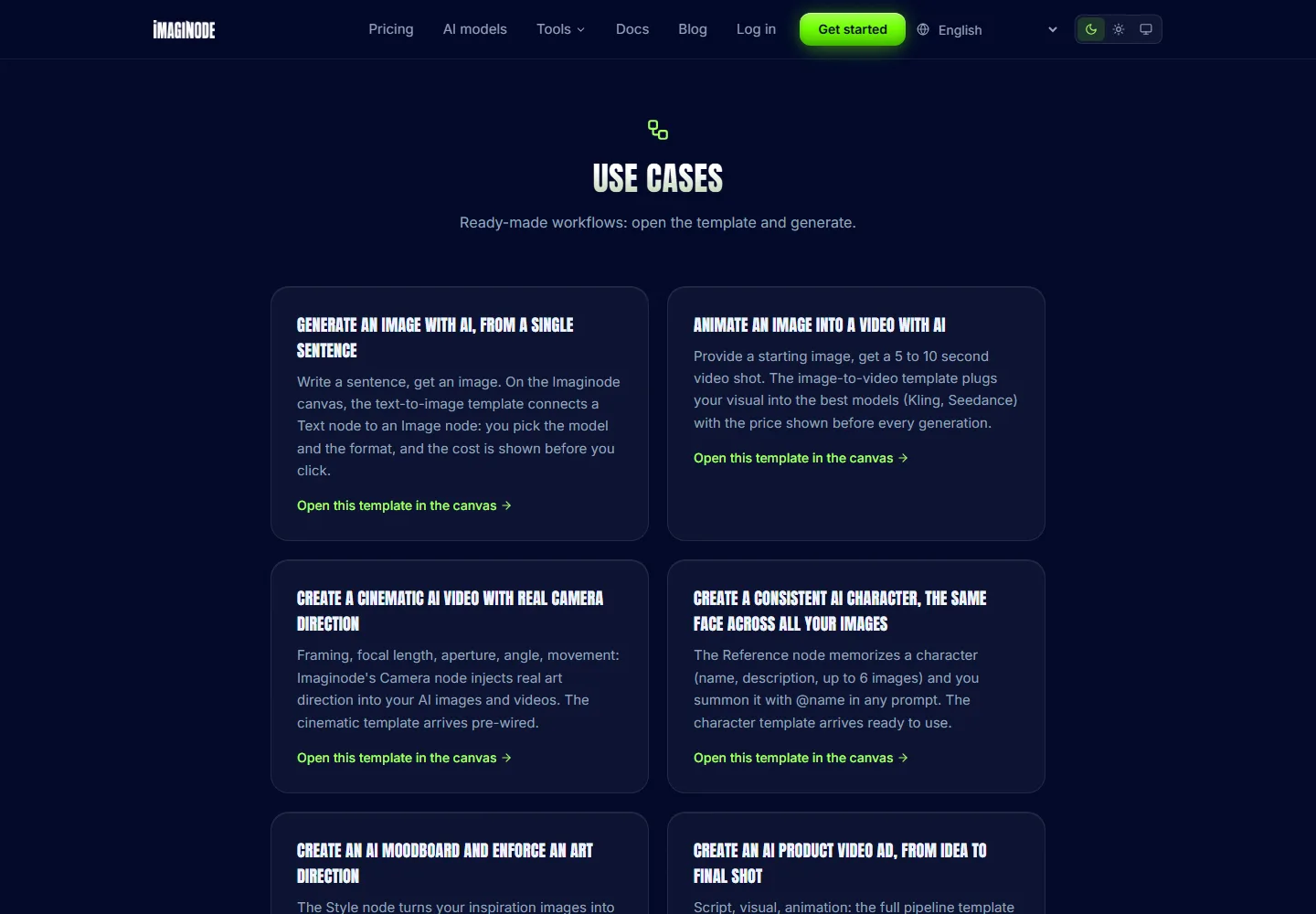
A reference node holds a recurring subject steady, storing a character as a name, a description and up to 6 images that any later prompt can call with an @name mention, and the published templates cover the obvious jobs including a product video ad from script to final shot. That solves subject consistency, which is the version of the problem a solo operator actually has.
It is not a team tool. No seats, shared workspaces, brand kits, role permissions or approval steps are documented on any tier, and a Studio plan described as suiting high volumes and classrooms is a volume tier rather than a collaboration tier. Consistency across several marketers stays a matter of your own discipline. That, and the unanswered rights question, are the two things to settle before it carries anything a brand has to stand behind.