 Tool profile
Descript
Edit video by editing its transcript, priced by media hours per person
Descript edits video and audio by editing the transcript, which removes timeline work from podcast and talking-head production, and the free plan carries 60 minutes of media a month. The binding constraint on paid plans is the monthly media minute and AI credit balance rather than the seat price, because it expires unused.
Visit DescriptIs Descript worth it?
- What it is
- Edit video by editing its transcript, priced by media hours per person
- Worth a look if
- Most of your editing is cutting speech, and 16 USD per person per month on annual billing covers your media hours.
- Skip it if
- You need motion graphics, colour grading or a timeline editor, or your footage has heavy crosstalk where transcript accuracy falls away.
- Cost to start
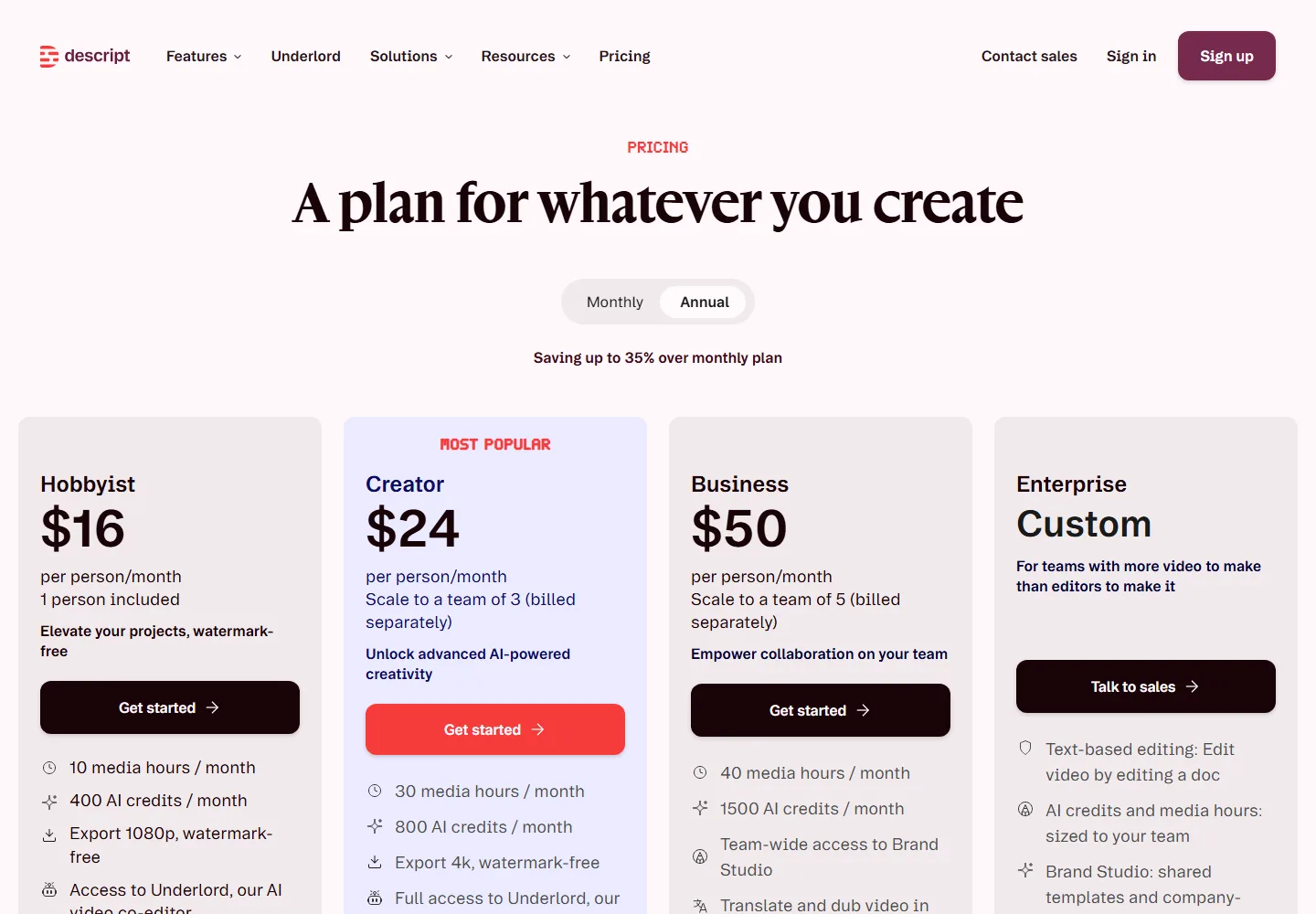
- 16 USD per person per month on annual billing for Hobbyist, 24 USD monthly. Yes. Free plan with 60 minutes of media per month, 1080p export, unlimited projects and text based editing.
Descript screenshots
Corrections
- This page originally stated that media hours were allocated per person and did not pool across a workspace. Descript's help centre documents the opposite: on team plans each seat contributes to a shared Drive pool that any Editor can draw on. The claim, the cons list and the billing note have been corrected, and the real constraint is that unused minutes expire monthly rather than that they fail to pool.
Descript at a glance
| Job category | Video and Image |
|---|---|
| What it replaces | Cutting interview video on a timeline editor |
| Pricing model | Free tier |
| Starting price | 16 USD per person per month on annual billing for Hobbyist, 24 USD monthly |
| Free tier | Free plan with 60 minutes of media per month, 1080p export, unlimited projects and text based editing. |
| Getting started | Free tier |
| Built for | Podcast and interview workflows where most editing is cutting speech |
| Company | Descript, Inc., United States. |
| Last verified | August 2026 |
Descript pricing and plans
Descript does not publish pricing. 16 USD per person per month on annual billing for Hobbyist, 24 USD monthly Free plan with 60 minutes of media per month, 1080p export, unlimited projects and text based editing.
- Hobbyist is 16 USD per person per month on annual billing, 24 USD monthly.
- The free plan covers 60 minutes of media a month with 1080p export.
- Media minutes and AI credits pool across the whole Drive on team plans, so one heavy editor can draw on a quiet colleague share.
- Per-person media hours are the binding limit for high-volume teams.
- AI features draw on a separate credit balance of 400, 800 or 1,500 by tier, so heavy Underlord use can exhaust the month before the media minutes do.
- Top-ups are sold only on Creator and Business, so the cheapest paid tier has no way out when it runs dry mid-month.
- On team plans each seat contributes media minutes to a shared Drive pool, so a three person Creator team has roughly 5,400 shared minutes rather than 1,800 each.
On team plans each seat contributes media minutes and AI credits to a shared Drive pool that any Editor can draw on. Unused minutes do not roll over. AI features consume a separate credit balance of 400 on Hobbyist, 800 on Creator and 1500 on Business, and top-ups are sold only on Creator and Business.
Descript features: what it does
- Deleting a sentence from the transcript deletes it from the video, which removes most of the timeline work
- Filler word removal and Studio Sound clean up interview audio with very little effort
- Media minutes and AI credits pool across the whole Drive on team plans, so one heavy editor can draw on a quiet colleague's share
- Voice cloning requires a recorded consent statement from the speaker, which is the right default
Descript limitations
- Unused media minutes expire at the end of each month, so an uneven production schedule wastes whatever you did not use
- 1080p export ceiling on Free and Hobbyist rules those tiers out for anything client facing
- Transcript accuracy drops noticeably with crosstalk, background noise and less represented accents, and every error becomes an editing error
- Viewers and project-level editors cannot consume media minutes or AI credits, so a read-only collaborator who needs to do real work still costs a full seat
Who Descript is for
| Your situation | What that means here |
|---|---|
| Podcast or interview producer | Most of that editing is cutting speech, which is exactly what transcript editing does best. |
| Marketing team making talking-head explainers | Social cutdowns from recorded speech are the workflow this removes most work from. |
| Motion graphics or colour work | Timeline editors exist for those jobs and this is not one. |
| High-volume production team | Per-person media hours become the binding limit, and unused minutes expire monthly. |
| Team recording noisy or crosstalk-heavy audio | Transcript accuracy falls away, and every transcription error becomes an editing error. |
| Marketer who never learned a timeline | The whole premise is that you do not need to, and it holds. |
Descript use cases for marketers
- Podcast and interview production, where deleting a sentence from the transcript deletes it from the video.
- Talking-head explainers and social cutdowns, with filler word removal and Studio Sound handling the audio cleanup.
Descript FAQ
Can Descript replace Premiere Pro or Final Cut?
For interview, podcast and talking-head work, largely yes, since that editing is mostly deciding which sentences to keep. For motion graphics, colour work or frame-accurate craft, no.
How accurate is the transcription?
Strong on clear single-speaker audio in common accents, and noticeably weaker with crosstalk, background noise, technical vocabulary and less represented accents. Test it on your worst recording.
Do I need permission to clone someone’s voice?
Yes, and Descript enforces it. Creating a voice requires the speaker to record a statement affirming identity and consenting to it. Voice and likeness are separately protected in several jurisdictions.
Descript sources and references
- Free includes 60 minutes per month at 1080p; Hobbyist is 24 USD monthly or 16 USD annually with 600 minutes at 1080p; Creator is 35 USD monthly or 24 USD annually with 1,800 minutes at 4K; Business is 65 USD monthly or 50 USD annually with 2,400 minutes at 4K; multi language transcription covers 25 languages on paid plans.descript.com
- Descript requires the speaker to read a statement affirming their identity and consenting to voice creation as part of training, and training data without that consent statement cannot be used to create the voice.help.descript.com
- On team plans each seat adds to a shared Drive pool of media minutes and AI credits that any Editor can use; unused media minutes do not roll over month to month; viewers and project-level editors cannot use features requiring them; and top-ups are sold only on Creator and Business plans, shared across the Drive, expiring twelve months after purchase.help.descript.com
Compiled by Alston Antony from the sources above:how we compile these entries and ouraffiliate disclosure.