
Competitive intelligence has a consistent failure mode, and it is not analysis quality. Someone produces a genuinely good competitor breakdown, publishes it somewhere sensible, and no salesperson ever opens it during a live deal. Crayon is built around fixing that, which is the right thing to build around.
The enablement focus is the product
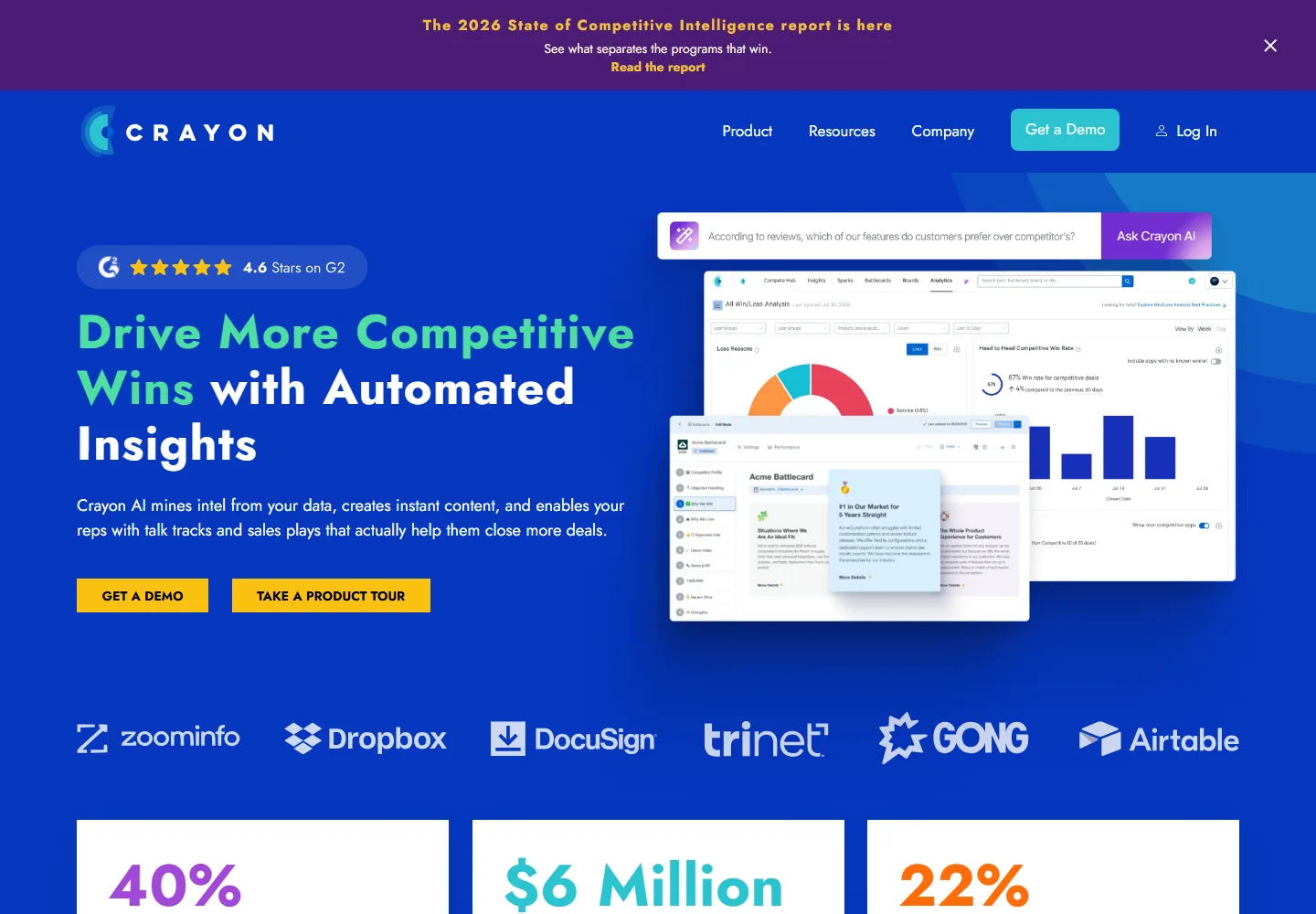
Battlecards, announcements, newsletters, and Sparks for recurring automated intelligence. The emphasis throughout is on getting a finding to a person who is about to need it, rather than on producing a more thorough document.
That is a workflow insight rather than a technical one, and it is probably why programmes built on this tool succeed where internal wikis do not. Intelligence has a short half-life, and the only version that changes an outcome is the version a rep reads before a call.
The measurement layer follows the same logic, with win/loss analysis, engagement metrics and influenced revenue. Being able to assess whether the programme changed anything, rather than assuming it did because the reports look good, is unusual in this category.
The question nobody answers
Nothing on the public site explains how Crayon collects competitor data.
That matters for two reasons. Reliability: data gathered from public pages, from third-party aggregators or by human researchers differs in freshness, coverage and error profile, and you need to know which you are relying on when a battlecard says a competitor changed their pricing.
And exposure: some sites prohibit automated collection in their terms. If a vendor gathers competitor data on your behalf in ways you would not do yourself, you have outsourced a decision without making it.
Every competitor tracking product faces this, and the good answer is straightforward to give. Ask in the first call. A vendor that describes its approach clearly is easy to trust; one that deflects has told you something.
AI importance scoring sits in the same territory. It decides which competitor changes surface to your team, which is a consequential filter, and no basis for the ranking is published. Ask what signals feed it and whether you can tune it, because the failure mode is a quiet one: things that mattered never appear and nobody knows to look.
On the success measure
Influenced revenue counts deals where a rep touched an intelligence asset. That includes deals that would have closed regardless, and it rises whenever adoption rises rather than whenever the intelligence was good.
A better measure exists and is achievable here: win rate on competitive deals, compared against a prior period or between reps using the programme and reps not. That comparison is uncomfortable to set up and it is the one that tells you whether to renew.
Define it before rollout. Once the default reporting is established, changing the measure looks like moving the goalposts, and by then the programme is being judged on a number that only goes up.