
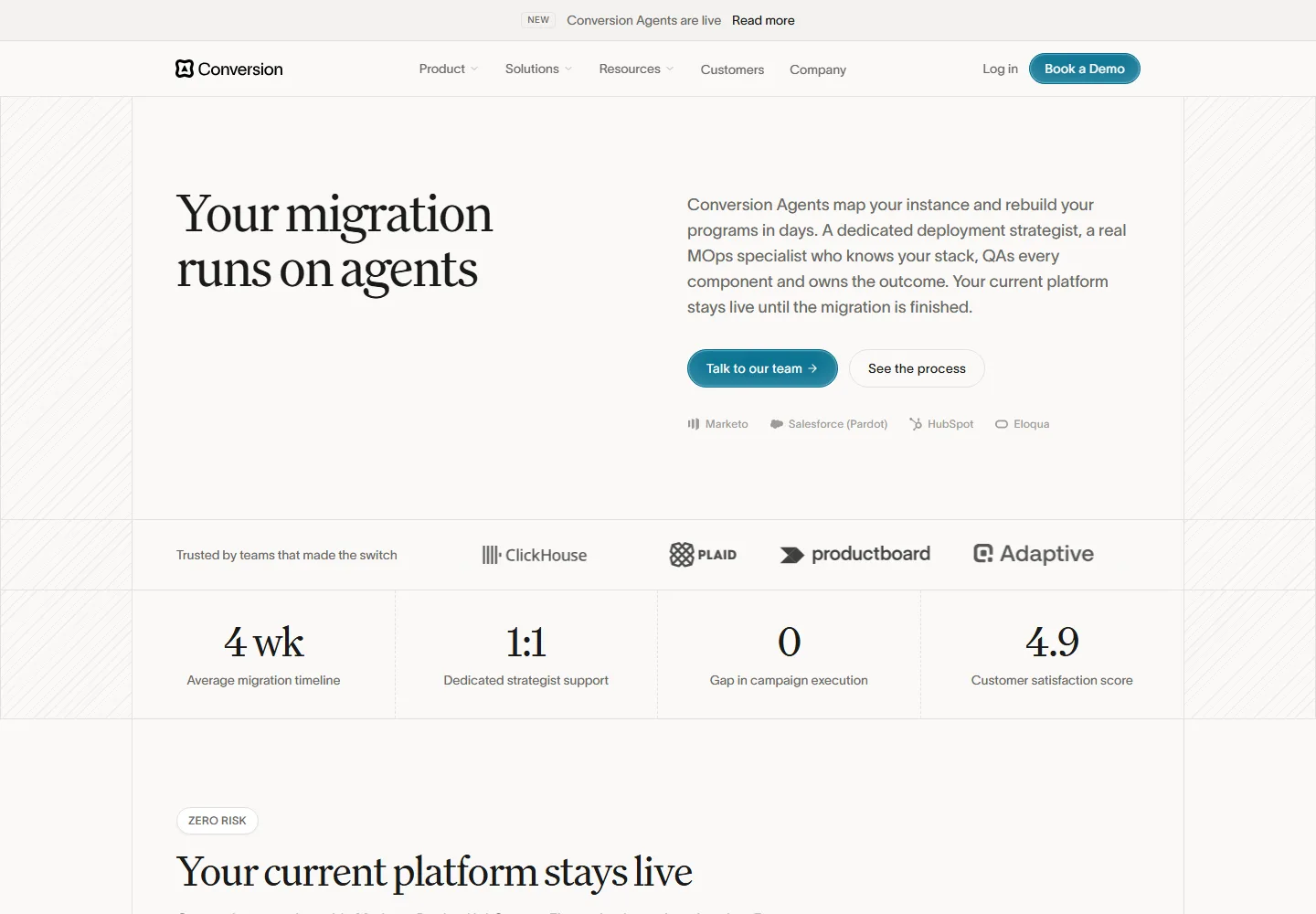
Conversion is aimed at a specific and widespread frustration: B2B teams paying enterprise prices for marketing automation bought a decade ago, maintained by specialists, and increasingly disliked by everyone who touches it.
Several tools make that pitch. What distinguishes this one is architectural.
The warehouse is the interesting decision
Traditional marketing automation keeps its own contact database. Data syncs in from Salesforce, from the product, from the warehouse, on some schedule. Segments are built against that copy.
The consequence is familiar to anyone who has run one: a segment looks wrong, marketing says the CRM is stale, sales says the marketing platform is stale, the data team says both are, and a week disappears. Nobody is lying; the systems genuinely disagree because they are synced snapshots of each other.
Querying Snowflake and BigQuery directly means segmentation runs on the same data, with the same definitions, as everything else in the business. For companies that have already invested in a warehouse, that removes a recurring category of argument rather than adding a capability.
Bidirectional Salesforce sync is the related good decision. Most B2B automation tools push to the CRM and read from it grudgingly, so the record of what marketing did lives in one system and what sales did lives in another. Two-way updates are how it should work and frequently is not.
The flexible data model with custom objects addresses the third structural annoyance: B2B relationships are not contacts and lists. Accounts have subsidiaries, deals have multiple buyers, products have entitlements. Systems that only model contacts force you to encode that in naming conventions and then live with it.
What the migration actually costs
Replacing an incumbent is where these projects fail, and the difficulty is not technical.
Programme logic accumulates over years. The person who built the lead routing has left. Nobody knows which of four hundred campaigns still run, or what breaks if a field added in 2019 stops being populated. The work of establishing what the old system does routinely takes longer than building the new one.
Budget a parallel period where both platforms operate, and count that in the comparison rather than treating the licence difference as the saving. Every vendor in this space understates it, not dishonestly, but because the archaeology is your organization’s problem rather than theirs.
The agents need a boundary
AI agents for tickets, QA, reporting and campaign builds are named without describing what they do autonomously.
That distinction matters more in marketing automation than almost anywhere else, because the consequence of an unsupervised error is an email to your entire database. Drafting a campaign for approval and launching one are very different capabilities behind the same word.
Ask what each agent does without a human, what it can send, and what the audit trail records. SOC 2 Type II certification and role-based access controls suggest the company thinks about governance, which is a reason to expect a good answer rather than a substitute for one.
The customer list, weighted toward mid-sized technology companies like ClickHouse, Plaid and Productboard, tells you where this currently fits best. Several are described as having replaced Marketo or Pardot, which is the specific claim the product is making and the most useful reference to ask about.