 Tool profile
Userled
AI agents for ABM campaigns, microsites and LinkedIn at account scale
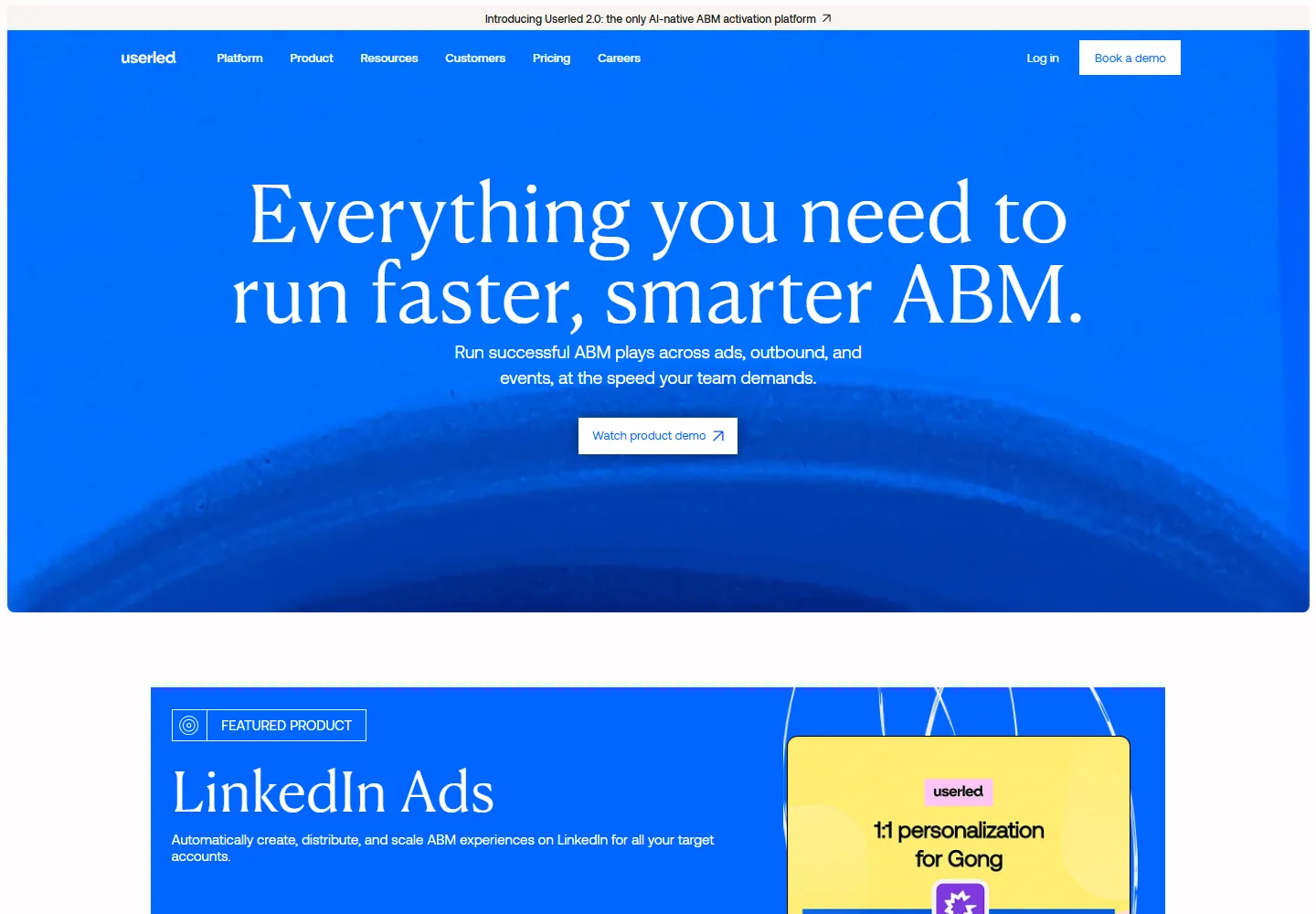
Userled runs account-based marketing through agents handling campaigns, content, bidding and insights, with personalized microsites per account. It depends on enrichment platforms bought separately, and every result it publishes is measured in influenced pipeline. Pricing is demo-led.
Visit UserledIs Userled worth it?
- What it is
- AI agents for ABM campaigns, microsites and LinkedIn at account scale
- Worth a look if
- You already run Demandbase or 6sense and need an activation layer, with fewer people than ABM normally requires.
- Skip it if
- You have no account identification stack for this to layer on, or your deal volume is too low for account-level personalization to pay back.
- Cost to start
- From 599 USD a month for the Sales Plugin, or 2,000 USD a month per module. No. None published.
Userled screenshots
Userled at a glance
| Job category | CRO and Personalization |
|---|---|
| What it replaces | A larger ABM team building account campaigns by hand |
| Pricing model | Paid only |
| Starting price | From 599 USD a month for the Sales Plugin, or 2,000 USD a month per module |
| Free tier | None published. |
| Getting started | Paid from day one |
| Built for | B2B teams running ABM with fewer people than the strategy normally requires |
| Company | Not published |
| Last verified | August 2026 |
Userled pricing and plans
| Plan | Price | What it includes | What that works out at |
|---|---|---|---|
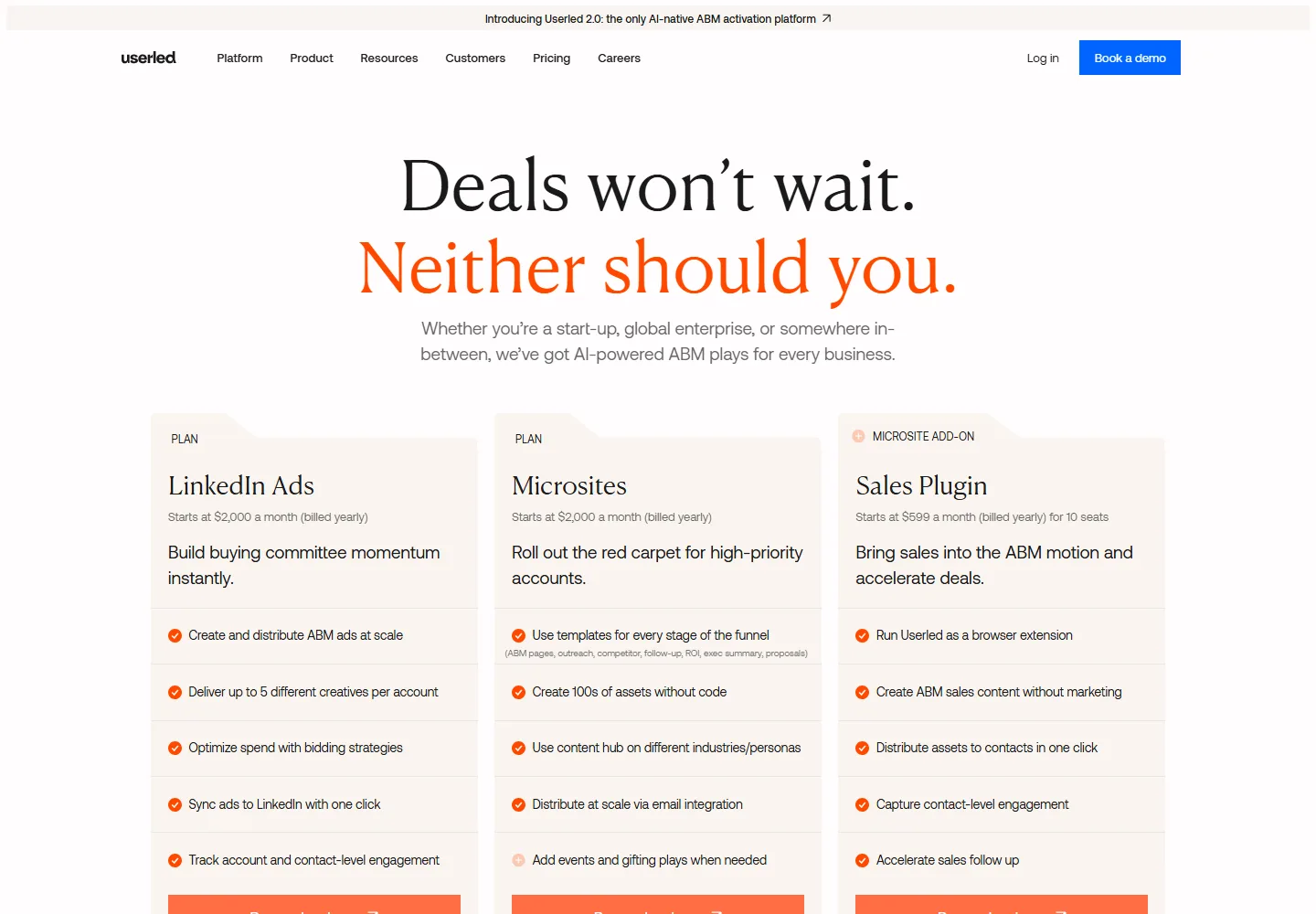
| Sales Plugin | From 599 USD a month billed yearly | 10 seats | About 59.90 USD per seat per month at the 10-seat floor. |
| LinkedIn Ads | From 2,000 USD a month billed yearly | The LinkedIn ABM advertising module | |
| Microsites | From 2,000 USD a month billed yearly | The personalized account microsite module | |
| Enterprise | Custom | SSO, dedicated CSM, 24/7 support |
- Pricing is per module rather than per platform, so the two modules the product is sold on cost 2,000 USD a month each and run to 4,000 USD a month together.
- The Sales Plugin is the cheapest way in at 599 USD a month for 10 seats, about 59.90 USD per seat.
- Everything is billed yearly, so the smallest published commitment is 7,188 USD for the Sales Plugin alone.
- The account identification layer is not included: Userled integrates with Demandbase and 6sense rather than replacing them, so that is a separate line item.
No public pricing. Budget the enrichment platform alongside it, since account prioritization depends on integrations with tools such as Demandbase and 6sense.
Userled features: what it does
- Four purpose-built agents for campaigns, content, bidding and insights rather than one general assistant
- Personalized microsites give each target account a destination rather than a generic landing page
- A sales plugin puts ABM content in the hands of the people who actually talk to the accounts
- Strong named customer list including Stripe, Ramp, Square, Canva, Elastic and Synthesia
Userled limitations
- Account identification relies on integrations with Demandbase and 6sense rather than proprietary capability, so the real stack cost is higher than the licence
- Published outcomes are stated as influenced pipeline, a measure with no agreed definition and no control group
- No pricing published, so cost cannot be assessed without a demo
- Account-level personalization carries consent and data obligations that the public material does not address
Who Userled is for
| Your situation | What that means here |
|---|---|
| Small B2B team running ABM | Purpose-built agents cover work that ABM strategy normally requires more people to do. |
| Demandbase or 6sense customer | Positioned as an activation layer on top of identification you already pay for. |
| Company without an identification stack | Account identification relies on those integrations, so the real stack cost is higher than the licence. |
| Marketer reporting to a finance director | Published outcomes are influenced pipeline, which has no agreed definition and no control group. |
| Sales-aligned organisation | A content plugin in the hands of the people who actually talk to accounts is where ABM content usually dies. |
| Low deal-volume business | Account-level personalization has to pay back against a small number of opportunities. |
Userled use cases for marketers
- ABM campaign execution through four purpose-built agents for campaigns, content, bidding and insights.
- Account-level landing experiences, giving each target account a personalized microsite rather than a generic page.
- Sales enablement, putting ABM content into a plugin used by the people who talk to the accounts.
Userled performance claims, checked
Userled quotes 13 million dollars of pipeline influenced within 3 months. Influenced pipeline counts deals an account touched rather than deals it caused, and the figure states no holdout, so it does not separate the programme from the account selection or the sales activity running alongside it.
Userled FAQ
Do I need Demandbase or 6sense as well?
Probably, and that changes the budget conversation. Userled consolidates signals and integrates with those platforms for account prioritization rather than replacing them, so the identification layer is likely a separate line item.
Is ABM worth it for a smaller B2B company?
It depends on deal size and account count. ABM economics work when a small number of accounts are each worth a lot, because per-account effort is high. If contract values are modest and you need volume, the same budget usually does more in demand generation.
Userled sources and references
- Userled describes an AI-native ABM platform with LinkedIn ABM ads, personalized microsites, a sales plugin, and Campaign, Content, Bidding and Insights agents, consolidating account and contact-level signals and integrating with Demandbase and 6sense for account prioritization. It lists more than 20 customer logos including Stripe, Ramp, Square, Canva, Elastic and Synthesia, and quotes outcomes including 13 million dollars of pipeline influenced within 3 months. No pricing is published.userled.io
- Userled publishes LinkedIn Ads starting at 2,000 USD a month billed yearly, Microsites starting at 2,000 USD a month billed yearly, and the Sales Plugin starting at 599 USD a month billed yearly for 10 seats. Enterprise is custom and adds SSO, a dedicated CSM and 24/7 support.userled.io
Compiled by Alston Antony from the sources above:how we compile these entries and ouraffiliate disclosure.