 Tool profile
Surfer SEO
Content optimization scoring plus AI answer tracking, sold by document credits
Surfer scores drafts against the subtopics competing pages cover and adds AI answer tracking, sold by document credits rather than seats, from 49 EUR a month for Discovery with 1 seat and 120 documents. Pricing by document prices your publishing volume rather than your team size.
Visit Surfer SEOIs Surfer SEO worth it?
- What it is
- Content optimization scoring plus AI answer tracking, sold by document credits
- Worth a look if
- You publish enough content to need a consistent pre-publish check, at 49 EUR a month for 1 seat and 120 documents.
- Skip it if
- Your problem is technical health or links rather than content coverage, or you publish at low volume, since credits expire against a monthly allowance.
- Cost to start
- 49 EUR per month for Discovery, 1 seat and 120 documents. No. No free plan. A 7 day money-back guarantee applies to first-time monthly subscribers, excluding add-ons, AI credits and overages.
Surfer SEO screenshots
Surfer SEO at a glance
| Job category | Content and Copy |
|---|---|
| What it replaces | Manually comparing a draft against competitor pages |
| Pricing model | Paid only |
| Starting price | 49 EUR per month for Discovery, 1 seat and 120 documents |
| Free tier | No free plan. A 7 day money-back guarantee applies to first-time monthly subscribers, excluding add-ons, AI credits and overages. |
| Getting started | Paid from day one |
| Built for | Content teams publishing enough volume to need a consistent pre publish check |
| Company | Not published |
| Last verified | August 2026 |
Surfer SEO pricing and plans
Surfer SEO does not publish pricing. 49 EUR per month for Discovery, 1 seat and 120 documents No free plan. A 7 day money-back guarantee applies to first-time monthly subscribers, excluding add-ons, AI credits and overages.
- Discovery is 49 EUR a month for 1 seat and 120 documents.
- Document credits expire against a monthly allowance rather than rolling over.
- The 7 day money-back guarantee applies to first-time monthly subscribers only, and excludes add-ons, AI credits and overages.
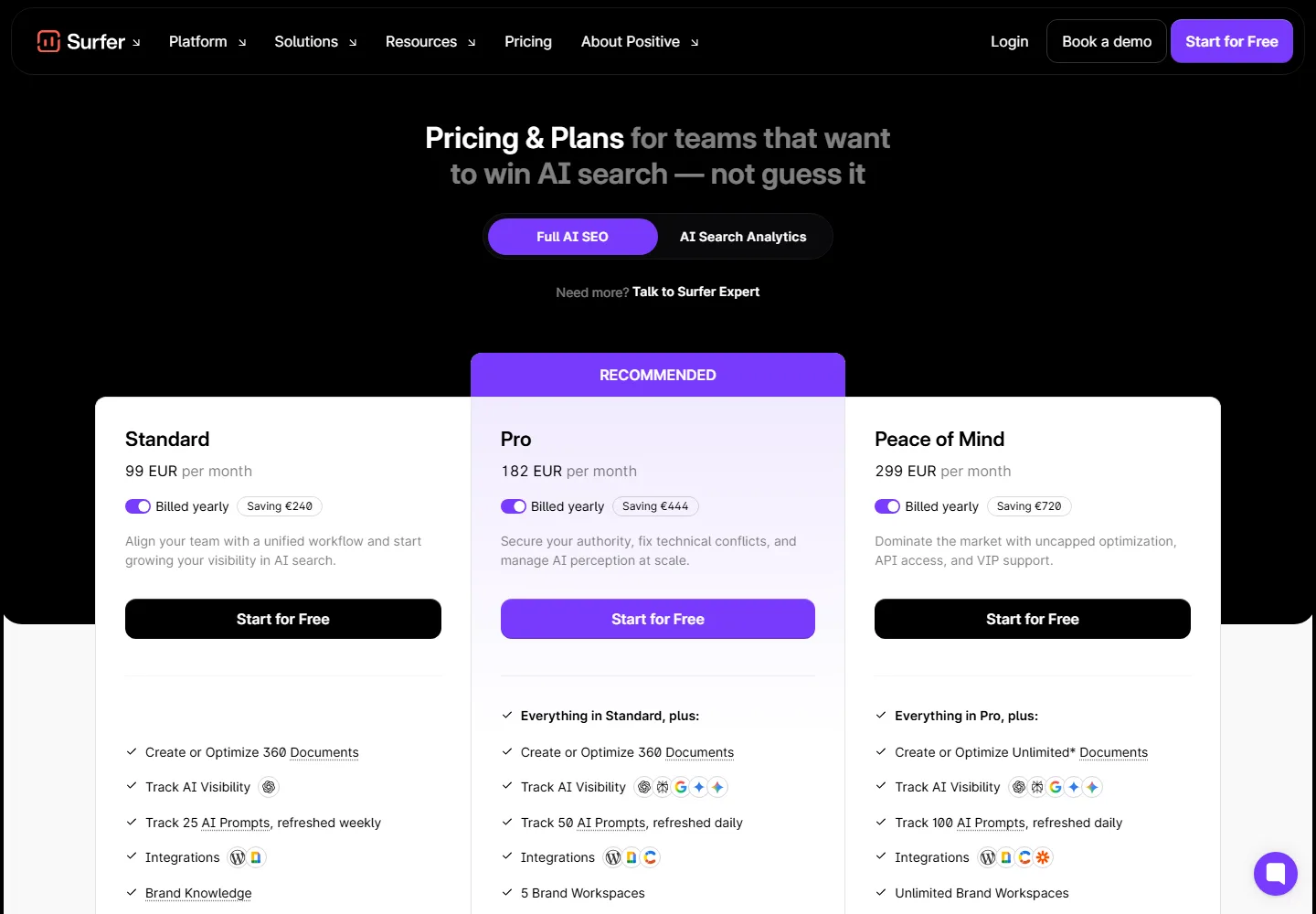
- Pro costs 83 EUR a month more than Standard and includes no additional documents, so it is the worst-value step in the ladder unless you need its seats.
Plans are priced by documents created or optimized per month, not by seat. Standard adds seats but not documents over Discovery.
Surfer SEO features: what it does
- Content Editor reliably surfaces subtopics competitors cover that your draft missed
- Topical Map turns a subject into a plannable cluster rather than a list of keywords
- AI Tracker monitors prompts across answer engines, which most SEO platforms still treat as an afterthought
- The interface is genuinely easy for writers who are not SEO specialists
- A 7 day money-back guarantee makes a first month a recoverable cost rather than a sunk one
Surfer SEO limitations
- Pricing is per document rather than per seat, so cost tracks output volume in a way that is easy to underestimate
- The Discovery plan is a single seat, which rules it out for most teams
- Optimization scores invite keyword padding when writers are measured on them
- The 7 day money-back guarantee covers first-time subscribers on monthly plans only, and excludes add-ons, AI credits and overages
Who Surfer SEO is for
| Your situation | What that means here |
|---|---|
| High-volume content team | Document credits suit consistent publishing, and the pre-publish check is the point of the tool. |
| Solo writer or freelancer | Discovery at 49 EUR covers one seat and 120 documents, which fits one person publishing steadily. |
| Multi-writer team | Discovery is a single seat, so a team is pushed to a higher tier before it needs more documents. |
| Technical SEO lead | If your problem is site health or links, content coverage scoring will not address it. |
| Editor guarding writing quality | Optimization scores invite keyword padding whenever writers are measured on them. |
| Team tracking AI answer engines | AI Tracker monitors prompts across answer engines, which most classic SEO platforms still treat as an afterthought. |
Surfer SEO use cases for marketers
- SEO content production, where Content Editor surfaces subtopics competitors cover that a draft missed.
- Content planning, where Topical Map turns a subject into a plannable cluster rather than a keyword list.
- AI answer engine visibility tracking through AI Tracker, alongside classic rankings.
Surfer SEO FAQ
Does a higher Surfer content score mean higher rankings?
No. The score measures similarity to pages currently ranking on term coverage and structure. That correlates with relevance but does not cause ranking, and pushing a score from 70 to 90 by adding terms frequently makes a page worse to read.
How do Surfer’s document credits work?
Plans include a number of documents you can create or optimize monthly rather than a number of seats. Discovery includes 120, Standard and Pro both include 360, and Peace of Mind is unlimited.
Do I still need Search Console alongside Surfer?
Yes, and it is free. Search Console reports the queries your site actually receives impressions and clicks for, which no third party can observe. Surfer models what competitors cover.
Surfer SEO sources and references
- Discovery is 49 EUR monthly with 120 documents and 1 seat; Standard is 99 EUR with 360 documents, 3 seats and AI Tracker at 25 prompts weekly; Pro is 182 EUR with 360 documents, 5 seats and AI Tracker at 50 prompts refreshed daily; Peace of Mind is 299 EUR with unlimited documents, 10 seats, API access and AI Tracker at 100 prompts daily. AI Search Analytics is sold standalone at 158 EUR monthly.surferseo.com
- Surfer offers a 7 day money-back guarantee to first-time subscribers on monthly plans, excluding add-ons, on-demand AI credits and overages. Cancelling a paid subscription does not refund it automatically; refunds are requested from support and reviewed case by case.docs.surferseo.com
Compiled by Alston Antony from the sources above:how we compile these entries and ouraffiliate disclosure.