
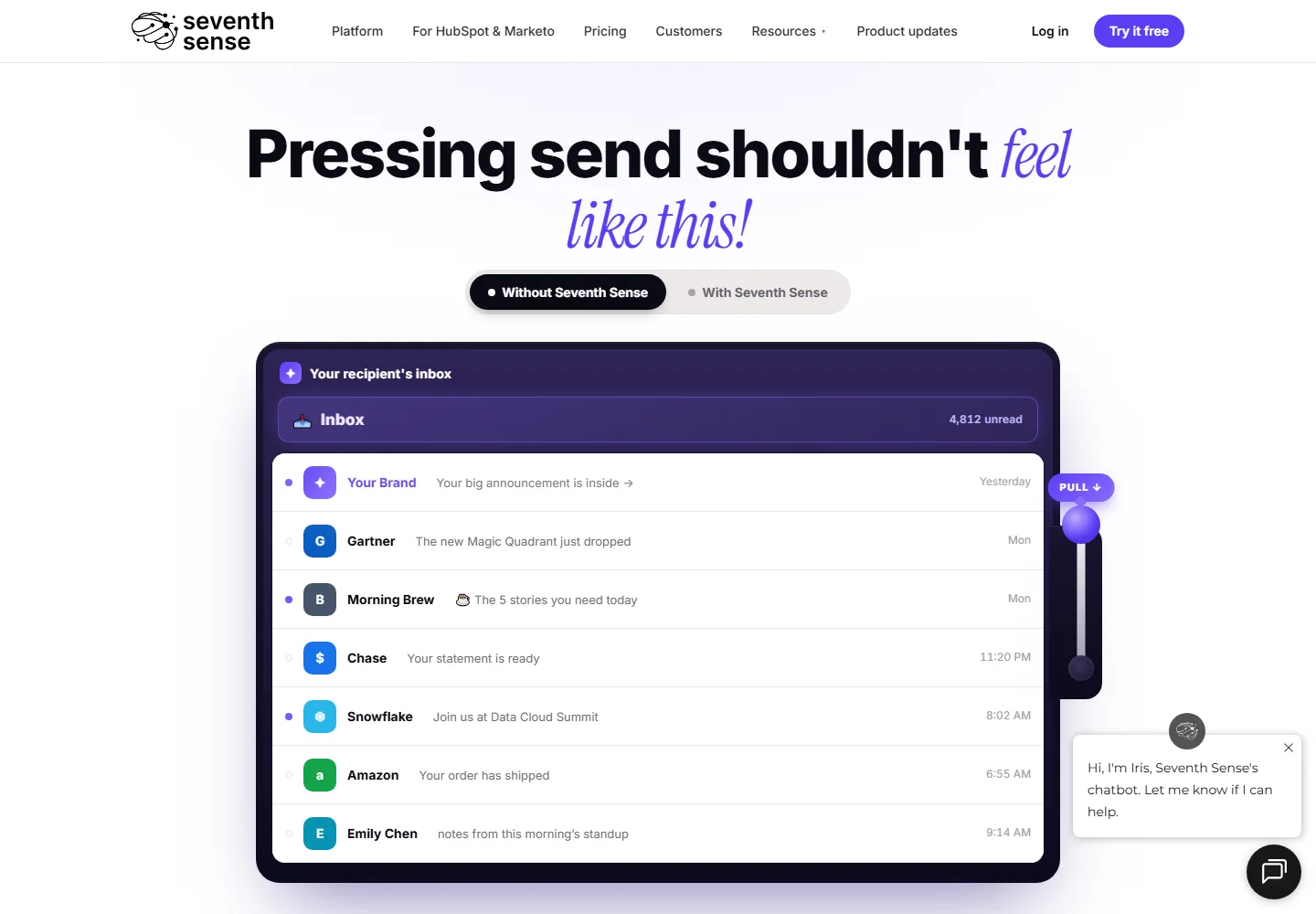
Seventh Sense does several things this site rarely gets to praise. It publishes its pricing. It refuses to charge per seat or bill overages. And it has spent twelve years supporting exactly two platforms rather than claiming twenty shallow integrations.
Then there is the thing it does not mention at all.
What it does well
The core idea is right. Most send time optimization computes one best hour for a whole list, which is an average of people with different jobs, time zones and habits, and averages of heterogeneous groups are usually true of nobody. Seventh Sense models each individual, updating continuously.
The deliberate narrowness is the other good decision. “Built for HubSpot. Built for Marketo. Built for nothing else” is unusual positioning in a market where integration count is a marketing metric. Send time optimization needs deep access to contact-level engagement history and to the sending pipeline, and that depth is exactly what broad integrations sacrifice.
Pricing at 400 dollars a month for 25,000 contacts, with unlimited users and no overage charges, is transparent in a category that mostly is not.
The omission at the foundation
Nothing in the public material mentions Apple Mail Privacy Protection.
MPP prefetches message content for Apple Mail users, registering an open regardless of whether a person looked at anything. Apple Mail is a substantial share of most consumer lists and a meaningful share of B2B ones. Since 2021 this has made open data an unreliable signal for individual behaviour.
A product that learns each person’s peak attention window from engagement data is built directly on that signal. If prefetched opens are not separated from human ones, the model risks learning when Apple’s infrastructure fetches mail rather than when your contact reads it. Those are different schedules and only one of them is useful.
This is a solvable problem. Click data is unaffected, and a model can weight clicks over opens or identify MPP-affected recipients and treat them differently. Seventh Sense may well do exactly that.
The point is that nothing published says so, and for a company whose entire product rests on engagement timing, addressing the industry-wide event that disrupted engagement timing would be the obvious thing to lead with. Ask on the first call how MPP is handled, and treat the answer as the main determinant of whether the product works for your list.
The list size question
Per-person models need enough observations per person. A list of 25,000 contacts emailed monthly gives each contact twelve data points a year, which is thin for establishing an individual rhythm rather than fitting noise.
No minimum is published. Ask what happens for contacts with insufficient history, since the honest answer is a fallback to segment or global timing, and the proportion of your list in that state determines how much of the product you are actually buying.
Where it fits
A HubSpot or Marketo team, sending frequently to a large list spread across time zones, with years of history and a satisfactory answer on MPP. On those conditions the pricing is fair and the depth is real. Without the MPP answer, you are buying a model trained on a signal that may no longer mean what it used to.