

Most organizations have a distribution problem rather than a creation problem. They commission a report, publish it, promote it twice, and move on, leaving the majority of its value unextracted. Lately.ai is built directly on that observation, and that focus is what makes it interesting.
The premise
Feed it long-form material and it produces platform-specific social posts, patterned on what has historically engaged your audience rather than on generic best practice. The Video Clip Autogenerator does the equivalent for long-form video, cutting highlights from material that otherwise sits on a channel getting nothing.
For a company producing webinars, podcasts, reports and long articles, that is a straightforwardly good trade. The content is already paid for. Extracting thirty posts from one asset is more valuable than generating thirty posts from nothing, and it also stays closer to things the organization actually knows.
Employee advocacy is the second half and it is treated seriously rather than bolted on, with staff able to share branded content in their own voices and parent dashboards for oversight. Advocacy programmes usually fail because employees are handed corporate copy they will not post; letting the system produce something that sounds like the person is the right instinct.
The question to ask on the first call
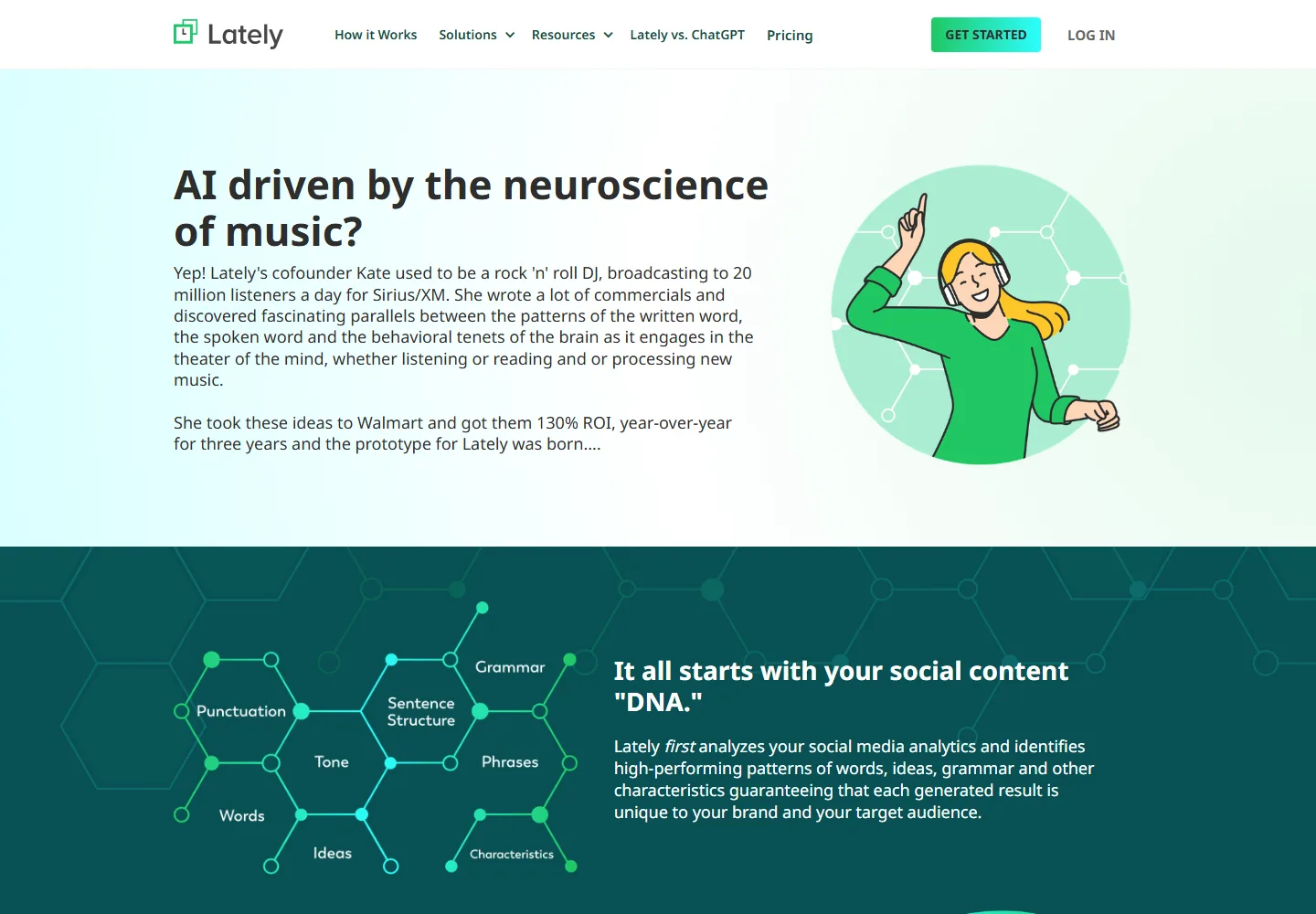
The differentiating claim is that Lately identifies high-performing patterns from your own engagement data rather than writing generically.
If true, that is a meaningful advantage. It also has a prerequisite nobody states: enough historical posts, with enough variation in outcome, for patterns to be distinguishable from noise. A brand with three years of consistent posting across several formats has that. A new account, or one that posts sporadically, does not.
Ask for the minimum directly, and ask what the product does before that threshold is met. The honest answer is presumably that it falls back to generic generation until sufficient data accumulates, which is fine, and is a different product from the one being sold.
What bounds the output
Repurposing inherits the quality of its source. A thin, hedged, committee-written report produces thin, hedged social posts more efficiently than a human would. The tool cannot add substance that was not in the material, and organizations whose long-form content is weak will find that automation makes the weakness more visible rather than less.
That is not a criticism of the software so much as a condition for it working. The companies that will get most from this are the ones already producing genuinely good long-form work and failing to distribute it.
On the headline statistic
The site leads with the claim that 99 percent of all social media messaging gets zero engagement, presented without a source, a definition of engagement or a description of the sample.
The underlying point is uncontroversial: most social posts reach very few people. The specific figure is not evidence, and for a product whose pitch rests on data discipline, an uncited statistic in the opening line is a slightly awkward place to start. Worth asking about, if only to see how the question is received.
No pricing is published, so as with much of this list, forming a view on value requires a conversation.