
Jasper sits in an awkward and interesting place. The underlying writing quality is broadly comparable to what you get from a general assistant, which is the part most buyers focus on and the part that matters least to the buying decision. What you are actually paying for is the layer around the model: brand voices that persist, knowledge assets that supply product specifics, agents that encode a process, and admin controls that decide who can do what.
What it is
Jasper is a marketing content platform built on top of general language models. The working surface is Canvas, where you assemble related content rather than generating one document at a time. Underneath sit three configuration objects that do most of the work: brand voices, knowledge assets and audiences. Agents wrap common marketing workflows so that a task follows the same steps every time it runs, and the Business tier adds a no-code builder for custom agents.
Who it suits
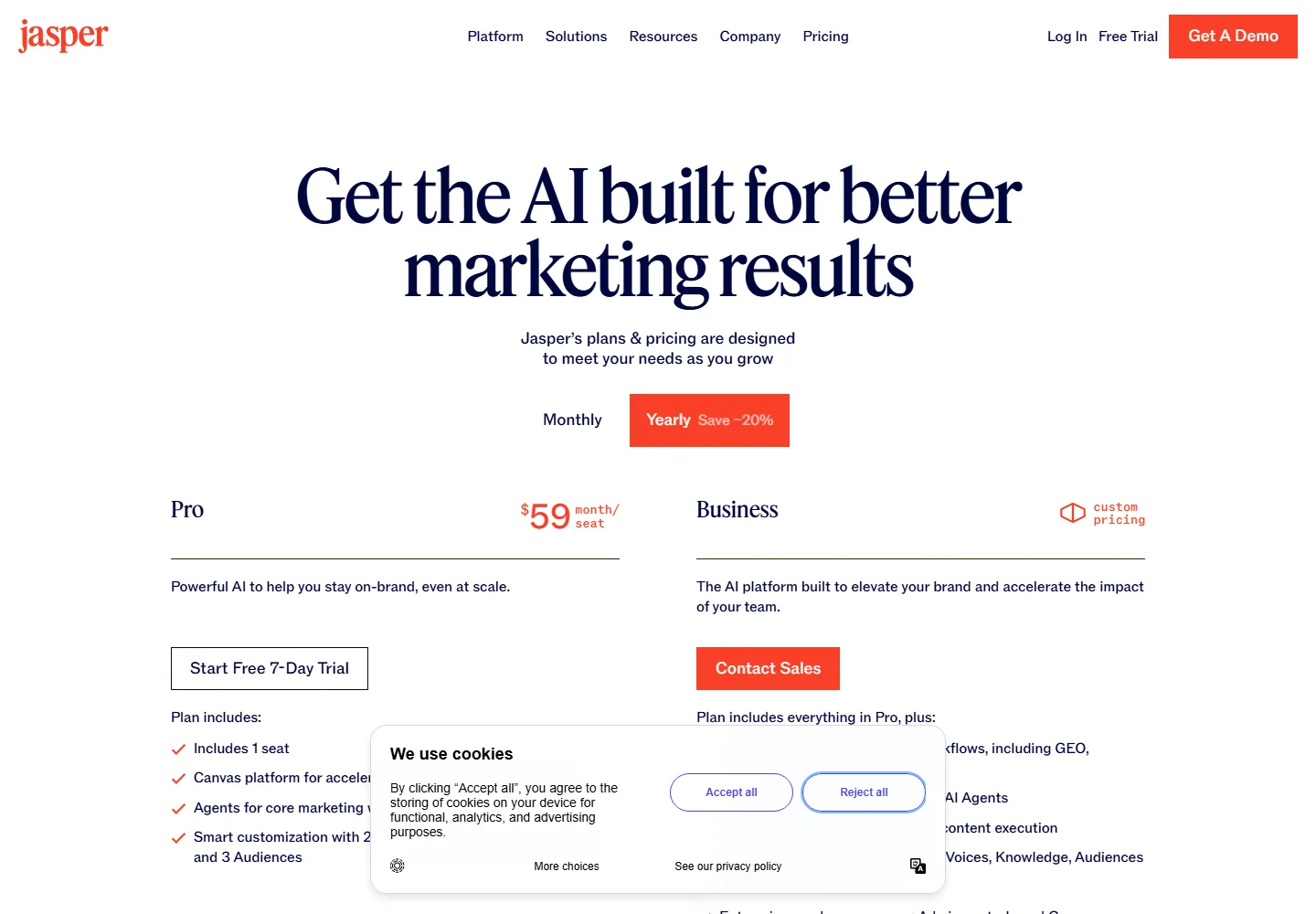
The economics only work at team scale. On the published pricing, Pro is 69 dollars per seat per month billed monthly, or 59 dollars per seat billed annually, with a seven day trial and no free plan. A solo marketer paying that is buying governance features they have no one to govern.
Where it earns its place is a marketing team of five or more people publishing regularly against a brand standard that someone is accountable for. In that setting the cost comparison is not against a general assistant, it is against the editing hours currently spent pulling inconsistent drafts back into voice. Agencies are the other clear fit, because separate brand voices per client is exactly the problem the product is shaped around.
The limits worth knowing before you buy
The Pro plan is capped at two brand voices, five knowledge assets and three audiences. An agency with four clients is already over that limit on day one, which pushes you toward Business and its quote only pricing. Budget for that conversation rather than being surprised by it.
The second thing to model is credits. Jasper states that some usage-based features, including the GEO Hub and agents, run on credits separate from the seat price. That means the seat cost is a floor rather than a total, and the variable portion depends on how heavily your team leans on those specific features. Ask for the credit rate card during the trial and estimate against your real volume.
On output quality and search
There is a persistent worry that publishing tool-assisted content damages search performance. Google’s own guidance is clearer than the discourse around it: the concern is generating many pages without adding value for users, which its spam policies treat as scaled content abuse. The production method is not the issue, the result is. Practically, that means Jasper does not change your SEO risk profile. Publishing unedited drafts does, whichever tool produced them.
Plan for a real edit pass on anything carrying a byline. The pattern we would expect, and which you should validate during the trial on a topic you know deeply, is that the tool supplies structure and a reasonable proportion of the sentences while a subject matter expert supplies the specifics that make the piece worth reading.
How to evaluate it in seven days
The trial is short, so do not spend it exploring features. Load one real brand voice with genuine examples rather than adjectives, load your actual product knowledge, and run a piece you were going to write anyway. Then measure the only number that matters: how much of the draft survived your edit. If the answer is most of it, the seat price is arguable. If you rewrote it, the platform has not solved your problem and no configuration will.