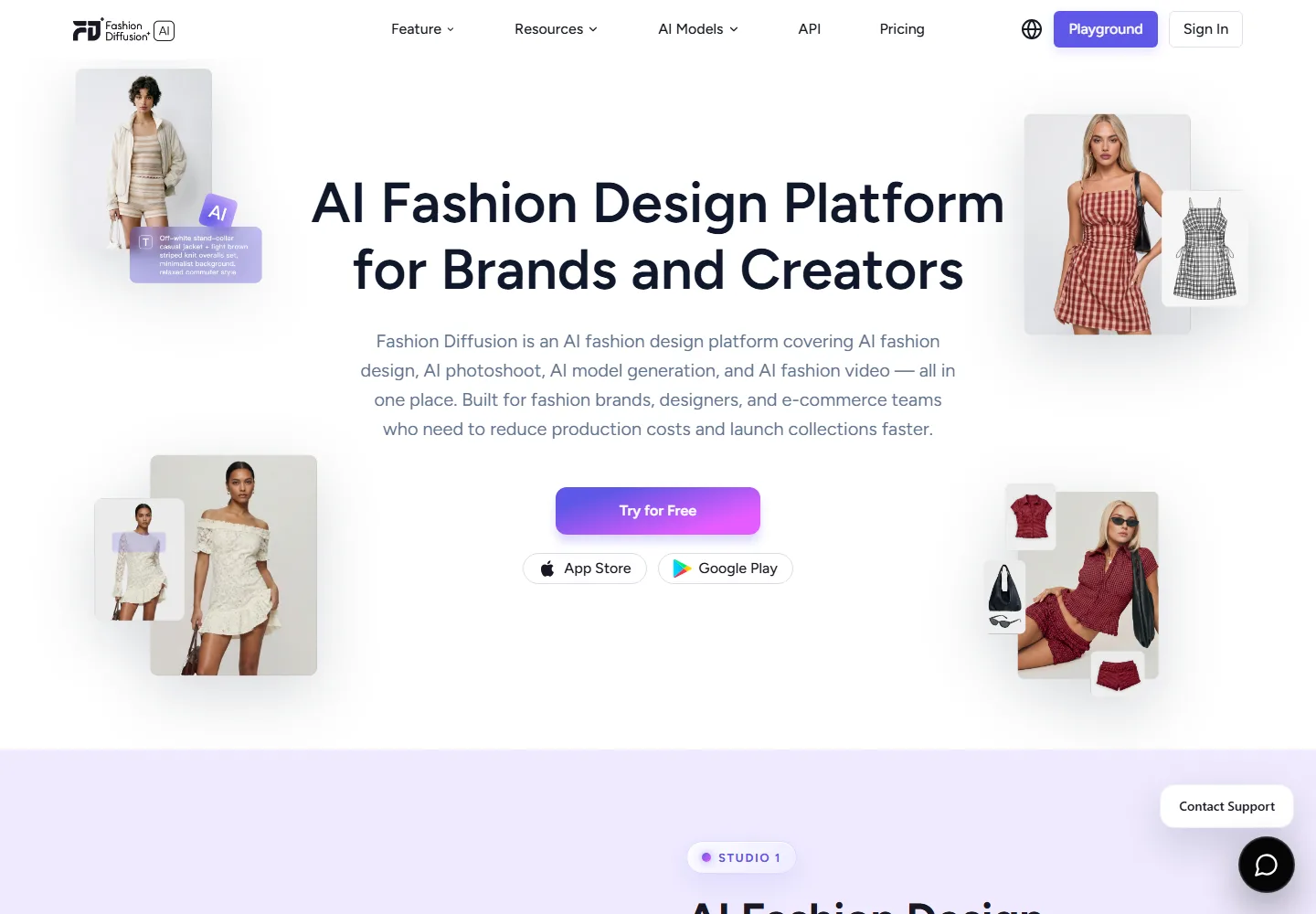
Fashion Diffusion is a fashion-specific image generator sold as three studios: design, photoshoot, and models and video. Roughly two dozen named tools sit inside them, from Text to Sketch and Apply Fabric at the concept end to Flat Lay Generator and background removal at the listing end. It appears in this category because what it produces is advertising and product imagery, not because it touches media buying.
The pitch is that it removes two costs from apparel production at once: the physical sample you would otherwise make to see a colourway, and the shoot you would otherwise book to photograph it. Both of those are genuinely expensive, and both are genuinely addressable by generated imagery. That much is a real proposition.
The pricing is unusually plain, and unusually incomplete
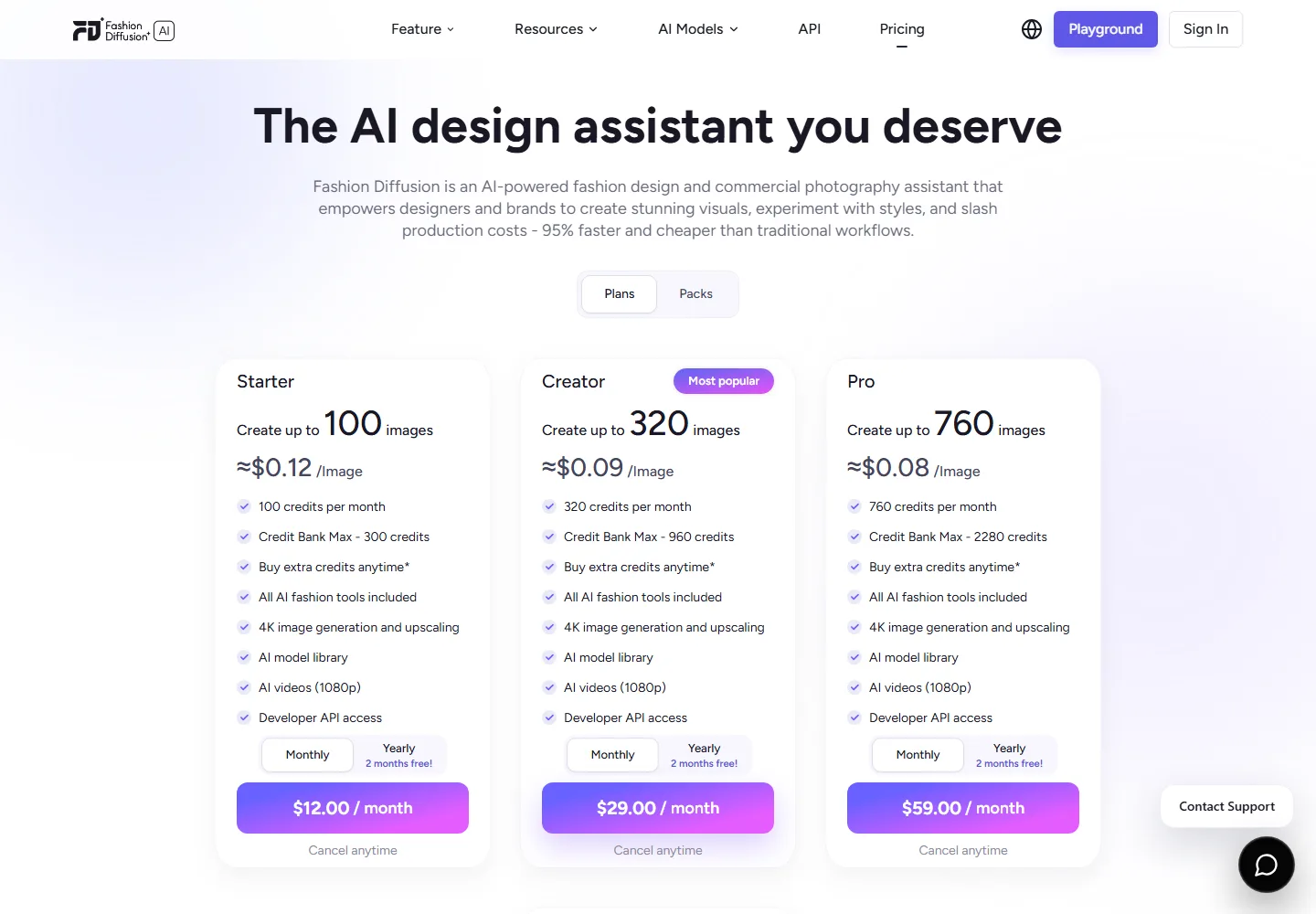
Four tiers are published, all of them with identical feature sets. Starter is 12 USD a month for 100 credits, Creator 29 for 320, Pro 59 for 760, Studio 199 for 2,800. Annual billing is described as two months free. Every tier includes every tool, 4K generation and upscaling, the model library, 1080p video and API access. There is no feature gating at all, which is rarer than it sounds and worth crediting: you are buying volume, and nothing else.
The vendor prints the effective rate on each card, falling from about 0.12 USD an image on Starter to about 0.07 on Studio, which is roughly a 40 percent difference between the cheapest and largest plan. Unused credits carry into a credit bank capped at three times the monthly allowance, which is 300, 960, 2,280 and 8,400 credits respectively. That cap is the part people miss. Credits do not expire monthly, but they stop accruing after roughly three months of underuse, so a plan bought ahead of a quiet quarter loses the overflow.
Then the gap. Each tier is quoted as a number of images, which sets the implied rate at one credit per image and makes the image side of the plan genuinely easy to size. Video and 4K upscaling are included on every plan and priced on none of them, and neither can plausibly cost a single credit. So the pricing page answers the question precisely for one output type and leaves it open for the two that consume the most compute. Ask support for the credit cost of a 1080p video and a 4K upscale before you pick a tier. If your work is mostly listing images, the published numbers are enough. If it leans on video, they are not.
Two answers to the commercial use question
The terms of service are clear in the direction that favours the buyer: all content generated by the platform is owned by the user, and the user retains full rights and licenses to use outputs, subject to applicable laws.
The virtual try-on page says something different. It states that the tool is free to start, that free credits are available on registration, and that paid plans are available for higher-volume generation and commercial use. Read plainly, that ties commercial use to a paid tier. The terms do not mention tiers at all.
Most likely this is loose marketing copy rather than a licensing position, and the terms govern. But “most likely” is not the standard you want when the image is already live on a product page and the garment is already selling. This is a one-email question. Send it, keep the reply, and file it with whoever signs off on your product photography.
The consent gap the product shape creates
Virtual Try-On, Swap Face and AI Model Generator all deal in human faces and bodies. Two of them accept uploads.
Nothing published explains how the AI model library was built, whether the faces are fully generated, licensed from real performers, or a mixture, and what consent was obtained in each case. The terms of service, meanwhile, carry no clause about uploading photographs of identifiable people. There is no prohibition, no consent requirement, and no allocation of responsibility.
That silence does not remove the obligation, it leaves it entirely with you. If someone on your team uploads a photograph of a real person into a face swap, the vendor’s terms have nothing to say about it and your own policy is the only thing standing there. Write one before you roll the tool out, rather than after.
Plus-Size Preview deserves a separate line. Showing a garment on a larger body when you have not photographed it on one is a claim about fit, made in an image rather than in words. In markets that regulate advertising accuracy, an image is not a softer claim than a sentence. Use it for internal range review freely, and check it against your own advertising standards before it reaches a customer.
What the homepage claims, and what is behind it
The homepage prints four benefit figures: three to five hours saved per design, sample costs reduced by 30 percent, up to three months saved a year, and sell-through increased by 12 percent. The pricing page adds a fifth, that the platform is 95 percent faster and cheaper than traditional workflows.
No methodology, sample size or study accompanies any of them. Sell-through in particular is a function of range, price, timing and demand, and attributing a 12 percent lift to the tool that made the pictures requires a controlled comparison that has not been published. Treat all five as marketing. The hours-per-design figure is at least the kind of thing a team could verify for itself in a fortnight, which is a better use of the free credits than reading the number.
Billing details worth reading before you subscribe
The refund clause describes subscription refunds as handled by Apple under Apple Media Services Terms, and states that the operator does not directly process refunds for Apple in-app purchases and cannot cancel subscriptions on a user’s behalf. That is written for the mobile apps. If you subscribe on the web, ask which route your subscription actually takes and who can cancel it, because the terms as written describe only the Apple path. The service is governed by French law with jurisdiction in Paris.
Where it fits
The honest version of the value here is narrower than the homepage and still substantial. For catalogue and marketplace imagery, where the constraint is shot count rather than creative direction, generating flat lays, ghost mannequin shots, detail crops and on-model images at 12 to 199 USD a month is difficult to argue against on cost. For colourway and fabric exploration before sampling, the same holds: seeing a print at scale on a garment shape beats imagining it, and costs a credit rather than a sample.
For the images that carry the brand, the calculation changes, because a hero shot is doing something a generated garment on a generated body does not reliably do, and because a returns rate is a real cost that flattering generated imagery quietly raises. Generate for volume, photograph what carries the brand, and settle the commercial use question in writing before either goes live.