 Tool profile
Anyword
Copy generation with performance scores, metered separately from the words
Anyword publishes full pricing, and the plans show that performance predictions are metered separately from generation, at 50 predictions a month on the entry plan. No methodology behind the predictive score is published anywhere.
Visit AnywordIs Anyword worth it?
- What it is
- Copy generation with performance scores, metered separately from the words
- Worth a look if
- You write ad variants in volume and want a predictive score before spend, at a published 49 USD a month or 39 USD billed annually.
- Skip it if
- You want a general writing tool, where cheaper options do the same job, or you need unlimited scoring on a lower tier.
- Cost to start
- 49 USD per month, or 39 USD billed annually. Trial only. No free plan. 7 day trial capped at 2,500 words.
Anyword screenshots
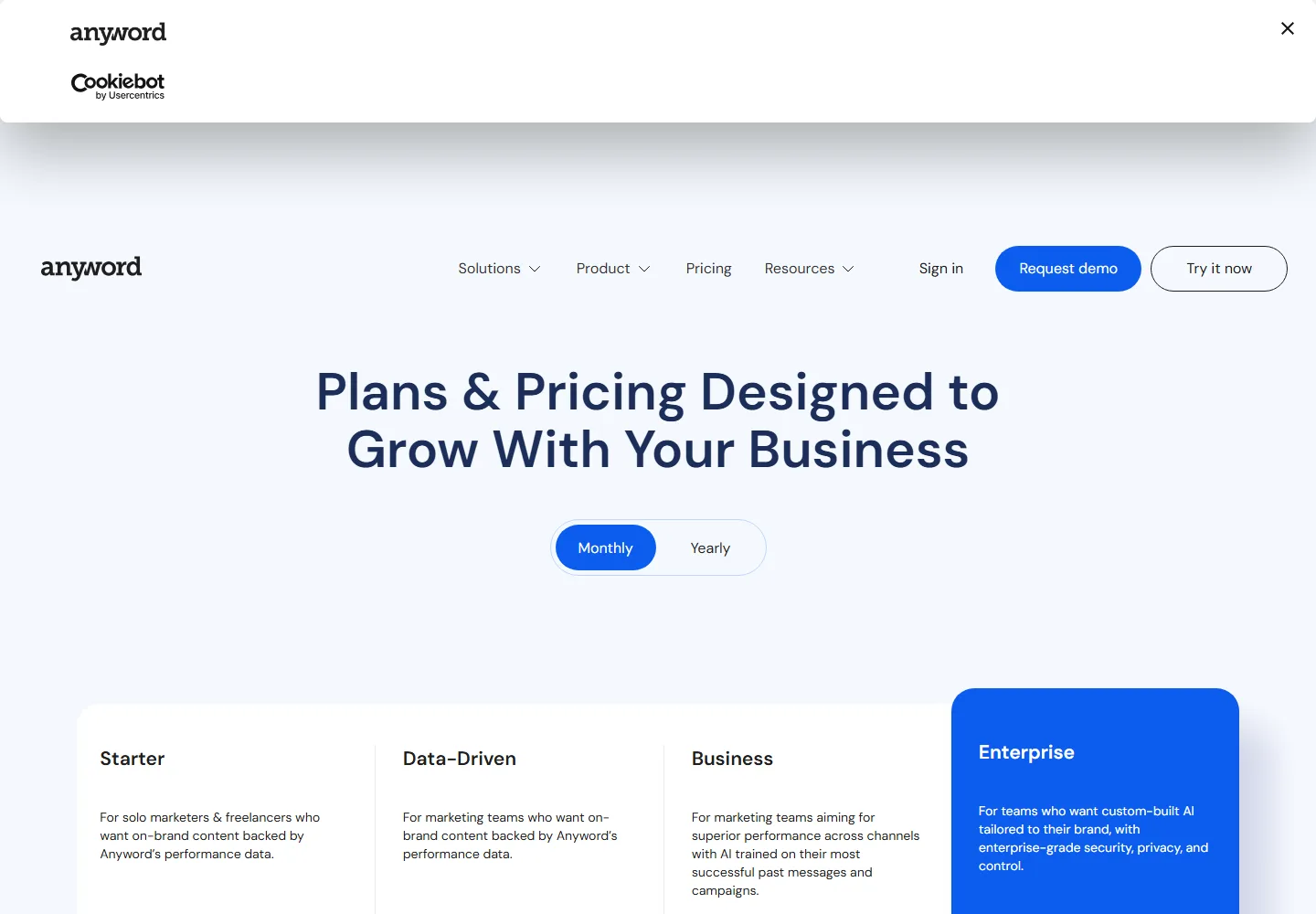
Anyword at a glance
| Job category | Content and Copy |
|---|---|
| What it replaces | Learning which ad copy works by buying impressions |
| Pricing model | Paid only |
| Starting price | 49 USD per month, or 39 USD billed annually |
| Free tier | No free plan. 7 day trial capped at 2,500 words. |
| Getting started | Free trial |
| Built for | Performance marketers who write high volumes of ad variants and want a pre-flight filter |
| Company | Not published |
| Last verified | August 2026 |
Anyword pricing and plans
Anyword does not publish pricing. 49 USD per month, or 39 USD billed annually No free plan. 7 day trial capped at 2,500 words.
- Predictions are the metered dimension, not words: 50 a month on Starter, 100 on Data-Driven, 250 on Business and 500-plus on Enterprise. Copy generation is unlimited on every tier.
- Performance data rows are metered separately, at 50 on Starter and Data-Driven, 5,000 on Business and 10,000-plus on Enterprise.
- Business and Enterprise are custom-priced, so only the first two tiers carry a public figure.
- Annual billing is 20 to 30 percent cheaper, at 39 USD for Starter and 79 USD for Data-Driven.
- The 7 day trial is capped at 2,500 words.
Seats and words are not the binding constraint. Performance predictions are, at 50 a month on Starter, 100 on Data-Driven, 250 on Business and 500 or more on Enterprise. Size the plan on predictions, not on word count.
Anyword features: what it does
- Full pricing is published across all tiers, including exactly what is metered, which is rare in this category
- Predictive scoring before spend is genuinely useful, since the alternative is learning the same thing by buying impressions
- Custom performance data can be fed in on higher tiers, which is what makes the prediction yours rather than generic
- Enterprise includes a private language model and SSO, so the data governance question has a real answer
Anyword limitations
- Performance predictions are metered at 50 a month on Starter and 100 on Data-Driven, which is very few for the feature you are buying the product for
- No prediction methodology is published, so what the score is trained on and how well it has held up is unknown
- Performance data rows are also capped, at 50 on the lower tiers against 5,000 on Business, which is a steep functional cliff
- The 7 day trial is limited to 2,500 words, which is not enough to evaluate prediction accuracy in any meaningful way
Who Anyword is for
| Your situation | What that means here |
|---|---|
| Performance marketer writing many variants | A pre-flight filter beats learning the same lesson by buying impressions, which is the alternative. |
| Team feeding in its own performance data | Custom data is what makes the prediction yours rather than generic, and it needs the Business tier to be meaningful. |
| Buyer on the entry plan | Fifty performance predictions a month is roughly two campaigns worth of the feature you are buying the product for. |
| General content writer | Cheaper tools generate copy just as well. The prediction is the only reason to pay this premium. |
| Analyst wanting to understand the model | No training corpus, accuracy figure or back-test is published anywhere. |
| Enterprise with governance requirements | A private language model and SSO on Enterprise give the data question a real answer. |
Anyword use cases for marketers
- Ad copy variant production for paid search and paid social, filtered by predictive score before any budget is committed.
- Landing page and email copy drafting where the same performance model scores both.
Anyword performance claims, checked
Anyword states on its homepage that it makes AI content perform 76 percent better and produces a 30 percent lift in business outcomes. Neither figure names a baseline, a control group, a time window or the accounts it is drawn from, and the two are not reconciled with each other. The product is a scoring layer, so the claim being made is that following its scores improves results; nothing published tests that.
Anyword FAQ
What is actually metered on each plan?
Performance predictions: 50 a month on Starter, 100 on Data-Driven, 250 on Business. Word count is generous and largely irrelevant. Size the plan against variants you want scored.
How accurate is the performance prediction?
Nothing published says. There is no stated training corpus, accuracy figure or back-test. Validate it by comparing predicted rank against actual results on your own spend.
Is the trial enough to evaluate it?
Not for the prediction. Seven days at 2,500 words tests the writing. Testing a score needs variants, live spend and weeks, so treat the trial as an interface check.
Anyword sources and references
- Anyword publishes Starter at 49 USD per month or 39 annually with 50 performance predictions, 50 performance data rows and 1 seat; Data-Driven at 99 USD or 79 annually with 100 predictions and 3 seats expandable to 10; Business at custom pricing with 250 predictions and 5,000 data rows; and Enterprise at custom pricing with 500 or more predictions, a private language model and SSO. A 7 day free trial is limited to 2,500 words.anyword.com
- Anyword states on its homepage that it works with any AI model or application, adding A/B-tested data at every step of the generation process, and claims the result is a 30 percent lift in business outcomes and AI content that performs 76 percent better.anyword.com
Compiled by Alston Antony from the sources above:how we compile these entries and ouraffiliate disclosure.