 Tool profile
Pencil
An orchestration layer over many AI models, with enterprise brand governance
Pencil aggregates OpenAI, Google, Adobe, Runway and Bria under one set of brand controls, having repositioned from predictive ad generation into orchestration. It is sold through a demo-led enterprise process with no published pricing.
Visit PencilIs Pencil worth it?
- What it is
- An orchestration layer over many AI models, with enterprise brand governance
- Worth a look if
- You produce creative across many markets and need brand governance and role-based access as core rather than enterprise add-ons.
- Skip it if
- You are a small team, where the value is in governance and scale, or you are shopping for performance prediction, which is no longer the positioning.
- Cost to start
- Not published. Demo-led enterprise sales process. No. None published.
Pencil screenshots
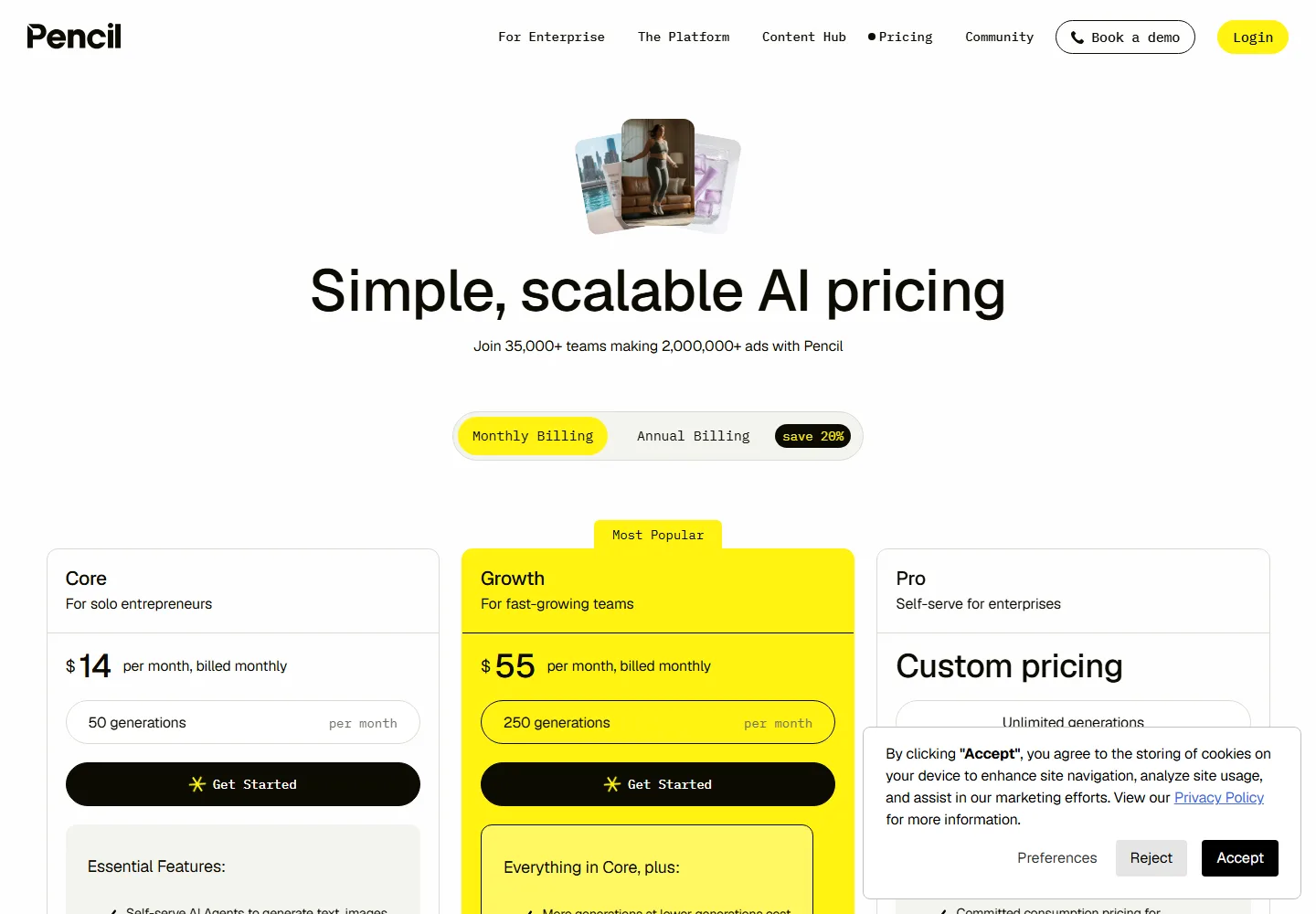
Pencil at a glance
| Job category | Ad Creative |
|---|---|
| What it replaces | Contracting separately with several AI model vendors |
| Pricing model | Paid only |
| Starting price | Not published. Demo-led enterprise sales process. |
| Free tier | None published. |
| Getting started | Sales contact required |
| Built for | Large brands producing creative across many markets who need consistent governance |
| Company | Not published |
| Last verified | August 2026 |
Pencil pricing and plans
Pencil does not publish pricing. Not published. Demo-led enterprise sales process. None published.
- No pricing is published. The sales process is demo-led and enterprise-shaped.
No public pricing. With aggregated models, clarify whether model usage is included in the licence or billed through, since generation costs vary considerably by provider.
Pencil features: what it does
- Aggregating OpenAI, Google, Adobe, Runway and Bria means model choice without vendor sprawl, and insulation when any single model changes
- Brand safety guardrails and role-based access controls are treated as core rather than enterprise add-ons
- Reference results are specific and operational, including L'Oréal at 33 percent cost reduction across 46,000-plus assets and Unilever scaling to 24 markets
- Positioning production savings as media growth is the right framing, since saved production budget can move into working spend
Pencil limitations
- No pricing published, so cost cannot be assessed without a sales process
- Share of Model, its measure of how AI perceives a brand, is asserted without published methodology
- Aggregating five model providers means five sets of terms and rights positions, and the public material does not describe how those are reconciled
- The product has repositioned from its earlier predictive framing, so older third-party comparisons describe a different tool
Who Pencil is for
| Your situation | What that means here |
|---|---|
| Large brand across many markets | Governance and consistency at scale is the entire proposition, evidenced by Unilever scaling to 24 markets. |
| Small team | The value is in governance and scale, and a small team has neither problem to solve. |
| Brand safety or legal reviewer | Guardrails and role-based access controls are treated as core rather than sold as enterprise add-ons. |
| Team wanting model choice without vendor sprawl | Aggregating OpenAI, Google, Adobe, Runway and Bria insulates you when any single model changes. |
| Buyer seeking performance prediction | That is no longer the product's positioning, so buying it for prediction misreads what it now is. |
| Procurement assessing rights | Five model providers means five sets of terms, and the public material does not describe how they are reconciled. |
Pencil use cases for marketers
- Multi-market creative production across OpenAI, Google, Adobe, Runway and Bria without managing several vendors.
- Brand safety review at creative volume, where guardrails rather than headcount are the throughput constraint.
Pencil performance claims, checked
Pencil publishes reference results including a 33 percent cost reduction across more than 46,000 assets at L’Oreal and Unilever scaling to 24 markets. These are production cost and coverage figures rather than performance claims, which makes them more checkable than most in this category, but neither states the baseline it is measured against.
Pencil FAQ
Is model aggregation valuable, or just convenient?
Valuable for a specific reason: model quality shifts constantly, and a team locked to one provider inherits every regression and pricing change. An orchestration layer lets you switch the model without rebuilding workflows, brand controls or the asset library.
What happened to the predictive positioning?
The product now presents as an orchestration and governance layer rather than a performance prediction engine. Older comparisons describing predictive AI ad generation are describing a different product.
Who is responsible for rights when five models are involved?
Worth asking directly, since commercial terms and indemnification differ between model providers and between plan tiers at the same provider. Aggregating them under one interface does not merge their terms.
Pencil sources and references
- Pencil describes itself as an AI operating system for marketing aggregating models from OpenAI, Google, Adobe, Runway and Bria, with workflows and orchestration, a unified editor, infinite canvas, content hub, brand safety guardrails and role-based access controls, and a Share of Model concept measuring how AI perceives a brand. Named customers include L'Oréal with a 33 percent cost reduction across more than 46,000 assets generated, Unilever scaling to 24 markets at twice the production speed, Japan Airlines, William Grant and Sons, Barilla and Samsung LATAM. No pricing is published.trypencil.com
- Commercial usage rights and indemnification for AI generated output vary by vendor and by plan tier, so aggregating providers means reconciling several rights positions.canva.com
Compiled by Alston Antony from the sources above:how we compile these entries and ouraffiliate disclosure.