 Tool profile
Hunch
Feed-driven creative automation for catalogue and multi-location advertisers
Hunch produces thousands of ad variations from a product feed or a location list rather than generating hero creative. Its published results report incremental ROAS rather than attributed ROAS, which is an unusually specific measurement claim for this category. Pricing is not published.
Visit HunchIs Hunch worth it?
- What it is
- Feed-driven creative automation for catalogue and multi-location advertisers
- Worth a look if
- You run dynamic product ads off a large catalogue or need thousands of localized variants, with no seat limits stated.
- Skip it if
- You need a single strong hero concept rather than many variations, or you have no product feed or location data to drive the automation.
- Cost to start
- Not published. Contact required. No. None published.
Hunch screenshots
Hunch at a glance
| Job category | Ad Creative |
|---|---|
| What it replaces | Hand-building localized ad variants from a product feed |
| Pricing model | Paid only |
| Starting price | Not published. Contact required. |
| Free tier | None published. |
| Getting started | Sales contact required |
| Built for | Ecommerce advertisers with large product catalogues running dynamic product ads |
| Company | Not published |
| Last verified | August 2026 |
Hunch pricing and plans
Hunch does not publish pricing. Not published. Contact required. None published.
- No prices are published. The pricing page is a demo request.
- The page states pay for what you use, no hidden fees and no seat limits, which confirms the absence of a seat tax but attaches no rate to the usage.
No public pricing, though the site states no seat limits and no hidden fees. Establish whether cost scales with ad spend, feed size or campaign volume before comparing.
Hunch features: what it does
- Reports incremental ROAS in at least one case study, which is a materially stronger claim than the attributed figures used across this category
- Hyper-local automation producing more than 2,000 localized ads in under 30 minutes addresses work that is otherwise impossible by hand
- Smart Product Sets group products using GA4 and conversion data rather than catalogue structure alone
- No seat limits is stated explicitly, which removes a common tax on collaboration in ad tooling
Hunch limitations
- No pricing published despite the site emphasizing fair pricing and no hidden fees, which is an awkward combination
- Value depends entirely on having a product feed or location data, so the tool does nothing for advertisers without either
- Other published figures, including 242 percent ROI lift and 77 percent lower CPA, are not described as incremental and should be read differently from the one that is
- Feed-driven creative converges visually across advertisers using the same templates, which erodes distinctiveness at catalogue scale
Who Hunch is for
| Your situation | What that means here |
|---|---|
| Ecommerce advertiser with a large catalogue | Feed-driven automation and Smart Product Sets are built precisely for catalogue-scale dynamic advertising. |
| Multi-location business | Over 2,000 localized ads in under 30 minutes addresses work that is otherwise impossible by hand. |
| Advertiser without a product feed | Value depends entirely on feed or location data, so the tool does nothing without either. |
| Brand needing one strong hero concept | This produces variation at volume, which is a different problem from concept quality. |
| Analyst assessing the evidence | At least one case study reports incremental ROAS, which is materially stronger than the attributed figures common in this category. |
| Buyer shortlisting on price | No pricing published, despite the site emphasising fair pricing and no hidden fees. |
Hunch use cases for marketers
- Catalogue advertising, grouping products into Smart Product Sets using GA4 and conversion data rather than catalogue structure alone.
- Multi-location paid social, producing more than 2,000 localized ads in under 30 minutes.
Hunch performance claims, checked
Hunch reports incremental ROAS in at least one case study. Incremental is a stronger claim than the attributed figures most of this category publishes, because it implies a holdout. The case study does not state the holdout design, the time window or the spend level, so the figure is not transferable to another account.
Hunch FAQ
Do I need a product feed to get value from this?
Effectively yes. The core capabilities take structured input and multiply it, so without a feed or location data there is nothing to multiply. Feed-driven automation propagates feed errors at the same speed.
Does automating thousands of variants hurt brand consistency?
It creates a risk worth managing. Template-driven output converges, and at catalogue scale nobody reviews every asset. Review output as a set, and keep some hero creative outside the automation.
Hunch sources and references
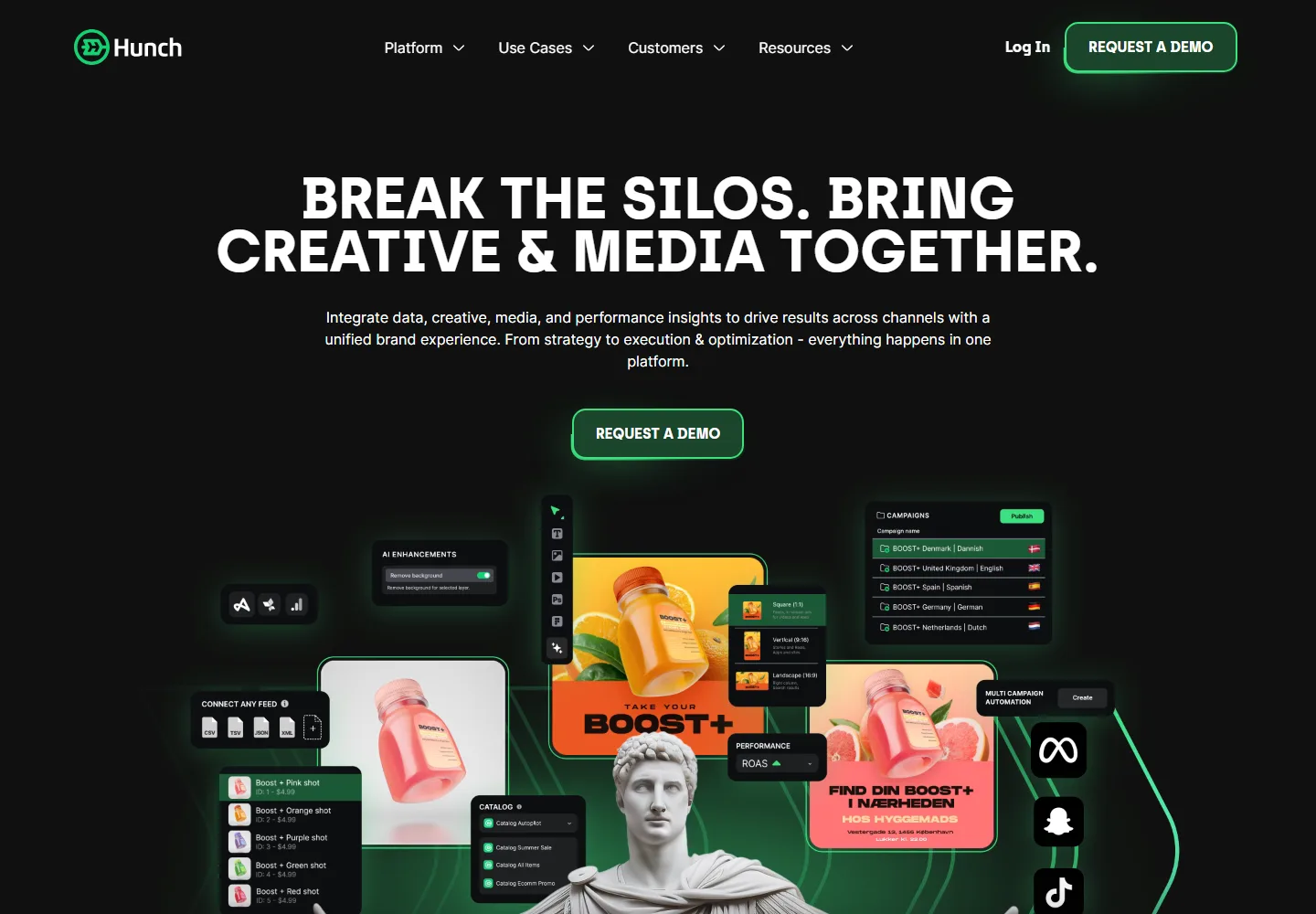
- Hunch describes creative automation across Meta, Snapchat, TikTok, Pinterest, Google Ads and Instagram, with enhanced dynamic product ads using AI background removal and colour matching, catalog product video generated from feeds, hyper-local automation launching more than 2,000 localized ads in under 30 minutes, Smart Product Sets driven by GA4 and conversion data, AI creative insights and bulk publishing. It states fair pricing with no hidden fees and no seat limits without publishing figures, and cites Academy Sports at 2.3x incremental ROAS, Carwow at 242 percent ROI lift and Kiwi.com at 77 percent lower CPA.hunchads.com
- Hunch publishes no prices. Its pricing page directs buyers to request a demo and states pay for what you use with full access to the AI tools, creative automation and cross-channel insights, no hidden fees and no seat limits.hunchads.com
Compiled by Alston Antony from the sources above:how we compile these entries and ouraffiliate disclosure.