 Tool profile
Crayon
Competitive intelligence built around sales enablement rather than reports
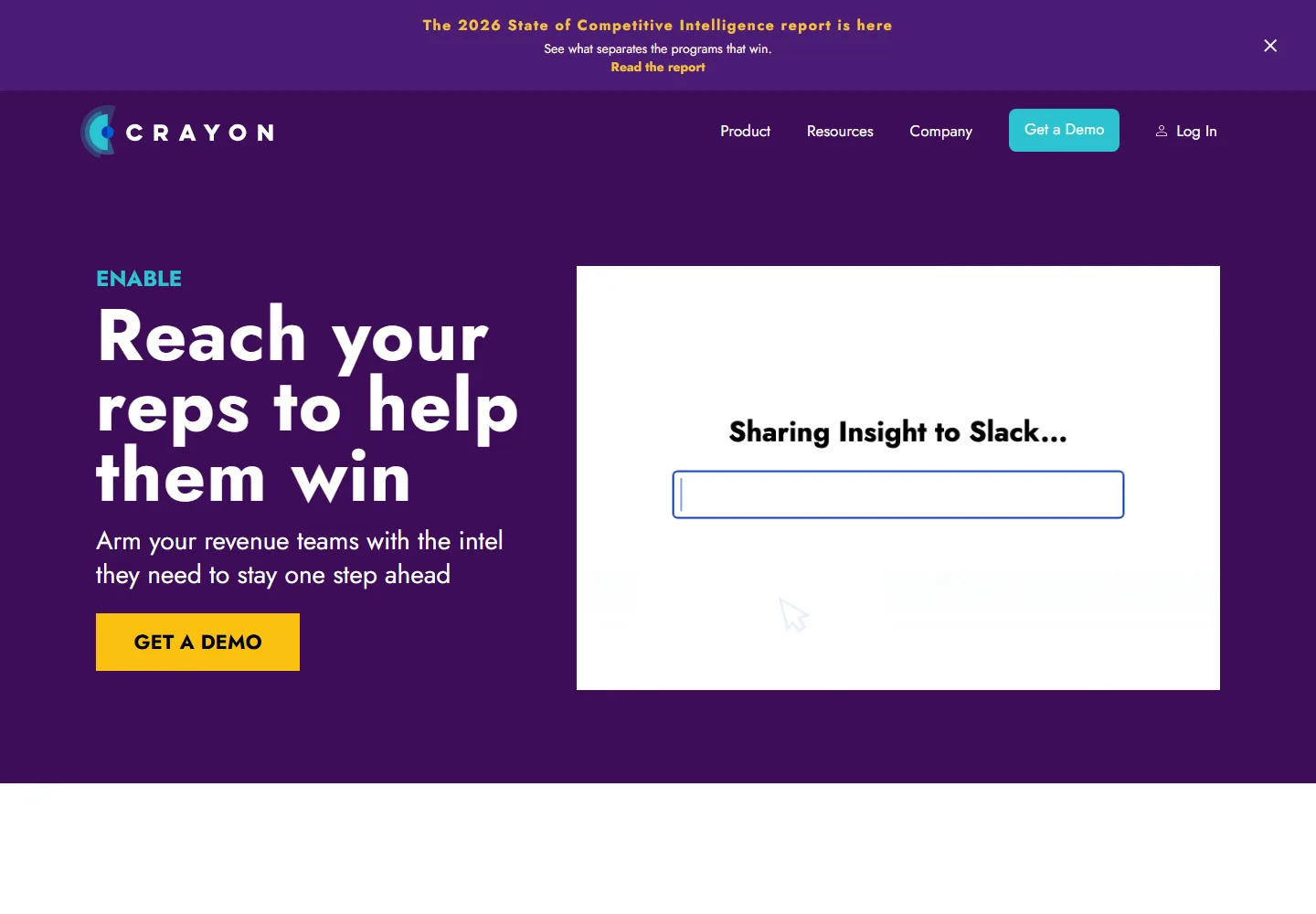
Crayon organises competitive intelligence around getting insight to sellers, with battlecards, win-loss and CRM delivery rather than a static report. It does not disclose how it collects competitor data, and pricing is demo-led.
Visit CrayonIs Crayon worth it?
- What it is
- Competitive intelligence built around sales enablement rather than reports
- Worth a look if
- You lose deals to a small number of known competitors and are accountable for sales enablement rather than reports.
- Skip it if
- You want market research rather than competitor tracking, or you need the collection method disclosed before shortlisting.
- Cost to start
- Not published. Demo-led sales process. No. None published.
Crayon screenshots
Crayon at a glance
| Job category | Research and Intelligence |
|---|---|
| What it replaces | Product marketers manually assembling battlecards from competitor sites |
| Pricing model | Paid only |
| Starting price | Not published. Demo-led sales process. |
| Free tier | None published. |
| Getting started | Sales contact required |
| Built for | B2B companies losing deals to a small number of known competitors |
| Company | Not published |
| Last verified | August 2026 |
Crayon pricing and plans
Crayon does not publish pricing. Not published. Demo-led sales process. None published.
- No prices are published. The pricing page is a Request an Estimate form.
- The stated pricing dimensions are the number of competitive assets and the number of stakeholders needing access, so cost scales with how widely the programme is used.
No public pricing. For competitive intelligence, establish whether cost scales with competitors tracked, seats, or both, since programmes usually grow on the first.
Crayon features: what it does
- Structured around enablement, with battlecards, announcements and newsletters rather than reports that go unread
- Measurement includes win/loss analysis and influenced revenue, so the programme can be assessed rather than assumed
- Sparks provides recurring automated intelligence rather than requiring someone to remember to check
- Credible B2B customer list including Alteryx, Cognism, Salsify and Allego
Crayon limitations
- The data collection method is not disclosed anywhere, so buyers cannot assess how competitor information is gathered or whether it respects site terms
- AI importance scoring decides what surfaces without any published basis for the ranking
- No pricing published, requiring a sales process
- Influenced revenue as a success measure has no agreed definition and no control group
Who Crayon is for
| Your situation | What that means here |
|---|---|
| B2B company losing deals to known competitors | Built around enablement for exactly that situation rather than around market reporting. |
| Product marketer accountable for enablement | Battlecards, announcements and newsletters are the artefacts this role is judged on. |
| Team wanting market research | This tracks named competitors, which is a different job from understanding a market. |
| Procurement assessing data practices | The collection method is not disclosed, so how competitor information is gathered cannot be assessed. |
| Organisation that will measure win rate | The programme becomes assessable rather than assumed, which is rare in this category. |
| Company without a live sales motion | Battlecards need deals to be used in, or the content is produced and never opened. |
Crayon use cases for marketers
- Competitive enablement, shipping battlecards, announcements and newsletters into live deals rather than into a shared drive.
- Win/loss and influenced-revenue reporting, so the intelligence programme can be measured against win rate.
Crayon FAQ
Why does the collection method matter?
It determines reliability and exposure. Competitor data can come from public pages, from sources whose terms prohibit automated access, from aggregators or from human researchers. Crayon does not describe which.
Is influenced revenue a useful measure of a CI programme?
Weakly. It typically counts deals where a rep touched an intelligence asset, including deals that would have closed anyway. Win rate on competitive deals is stronger. Define the measure before rollout.
Crayon sources and references
- Crayon describes a competitive intelligence platform with Crayon AI, components for aggregating, organising and publishing intelligence, sales enablement outputs including battlecards, announcements and newsletters, Sparks for automated recurring intelligence reports, AI news summarisation and AI importance scoring, and measurement covering win/loss analysis, engagement metrics and influenced revenue. Named customers include Alteryx, Cognism, Salsify, Allego, Reputation and Affinity. The data collection method is not specified and no pricing is published.crayon.co
- Crayon publishes no prices. Its pricing page carries a Request an Estimate form and states that pricing is tailored to the needs of the competitive intelligence programme, varying with competitive assets and stakeholder access.crayon.co
Compiled by Alston Antony from the sources above:how we compile these entries and ouraffiliate disclosure.