In this guide16 sections
- Key Takeaways
- What Is AI Actually Changing in Marketing Right Now?
- Original Evidence Behind These Predictions
- How Is AI Changing the Way Customers Find Brands?
- Will AI Replace Marketers and Copywriters?
- How Will AI Change SEO?
- Can AI Deliver Real Personalization at Scale?
- How Is AI Changing Advertising?
- How Does AI Change Marketing Measurement and Attribution?
- Will AI Agents Run Marketing Campaigns on Their Own?
- What Will AI Not Change About Marketing?
- What Skills Will Marketers Need in the AI Era?
- What Are the Real Risks of AI in Marketing?
- How Do You Prepare Your Marketing for AI Right Now?
- Frequently Asked Questions
- The Bottom Line
I have tested more than 500 AI, SEO, and SaaS tools with my own money, and I lead AI products at Brainstorm Force, including ZipWP. So here is the honest version of how AI is changing marketing: what is happening now, what is coming, what stays the same, and what to do about it.
Key Takeaways
- AI moves marketers up the stack. Routine production gets automated. The scarce skill becomes deciding what to make and owning the result.
- Search is splitting in two. Blue links still matter, but AI answer engines now sit in front of them. Getting cited by AI is its own discipline.
- Personalization gets real, but only with clean first-party data. Without it, AI just personalizes noise faster.
- The biggest risk is sameness. Same models plus same prompts equals the same average content. Distinctiveness becomes the moat.
- What will not change: people buy from brands they trust, positioning beats tactics, and someone still owns the outcome.
What Is AI Actually Changing in Marketing Right Now?
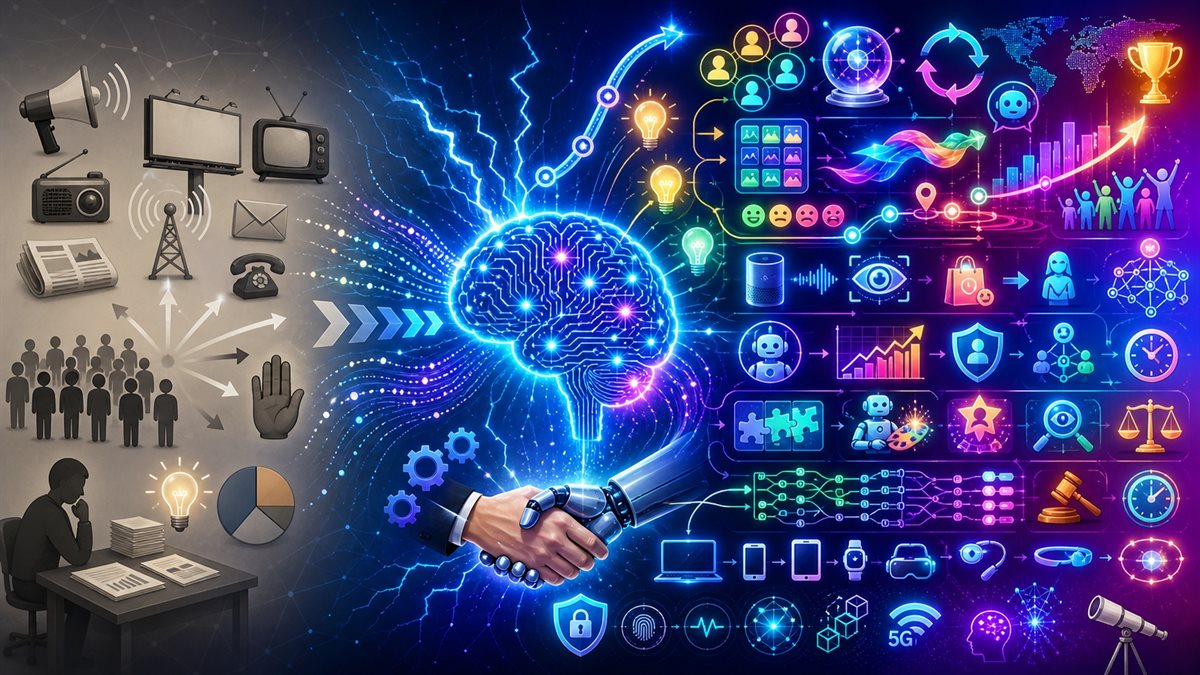
AI changes marketing in three concrete ways: it produces first drafts and variations of any asset in seconds, it sits between your audience and the web as an answer layer, and it automates the repetitive decisions inside ad platforms and CRMs. Everything else follows from those three.
The key shift is that production cost has fallen to near zero. A meta description, an ad variation, a subject line: producing one more version now costs almost nothing. That makes the output less valuable and the judgment about which output to use more valuable.
| What AI is changing | What it is not changing |
|---|---|
| Cost of producing content and creative | Whether the content is worth reading |
| The interface (chat answers vs 10 blue links) | The need to be a trusted source |
| Manual bidding, targeting, and reporting | Strategy, offer, and positioning |
| Speed of data analysis | Quality of the underlying data |
Original Evidence Behind These Predictions
Predictions are more useful when you can see what they are based on. I use three kinds of evidence here: measured changes in my own workflow, observed outcomes from products I have worked on, and repeated patterns from testing tools. They do not all carry the same evidentiary weight.
| Evidence | Observed result | What it supports | What it does not prove |
|---|---|---|---|
| My AI-assisted video workflow | Production time fell from 5 to 6 hours to 10 to 15 minutes | AI can remove a large production bottleneck when the workflow is clearly defined | That every creator, format, or team will achieve the same reduction |
| AI-assisted SEO work on ZipWP | Organic clicks increased 74% | AI can accelerate research and execution inside a human-directed SEO process | That AI alone caused every additional click; content, technical work, demand, and time also contribute |
| More than 500 AI, SEO, and SaaS tools purchased or tested | The durable gains repeatedly came from narrow workflows with clear inputs and review | Task fit matters more than how many AI features a product advertises | A controlled head-to-head benchmark of all 500 products |
The video result is the cleanest time measurement. Converting the ranges to minutes gives a reduction between 95% and 97.2%. The ZipWP result is a real project outcome, but it is observational, not a randomized experiment. I use it as evidence that an AI-assisted process can contribute to growth, not as proof that installing an AI tool creates a 74% lift.
The AI Tools Marketer Task-Autonomy Scorecard
I use a simple five-risk test before deciding whether AI can act on its own. Add one point when a task is public, spends money, makes a regulated or factual claim, is difficult to reverse, or has no fast objective check. A higher score requires more human control.
| Marketing task | Risk score | Recommended AI role | Human control |
|---|---|---|---|
| Summarize internal notes | 0/5 | Automate | Spot-check important details |
| Cluster keywords by intent | 1/5 | Automate the first pass | Review ambiguous clusters |
| Draft subject lines or ad variations | 1/5 | Generate options | Select and edit before testing |
| Produce a weekly performance summary | 2/5 | Draft from approved data | Verify calculations and conclusions |
| Publish a branded social post | 3/5 | Draft and schedule | Approve before publication |
| Answer a customer complaint | 3/5 | Suggest a response | Human owns sensitive cases |
| Change advertising bids or budgets | 4/5 | Recommend or act within hard limits | Monitor spend and approve material changes |
| Publish legal, medical, or financial claims | 5/5 | Research support only | Qualified human review is mandatory |
This scorecard is an original decision framework, not a performance benchmark. It turns “Should we automate this?” into a reviewable decision. It also aligns with the broader principle in the NIST AI Risk Management Framework: oversight should reflect the context and risk of the system being used.
Want to feel the shift in two minutes? Run a real meta description or ad-copy task through an approved AI assistant. Notice how fast you get usable drafts, and how much your judgment still decides which one is good.
How Is AI Changing the Way Customers Find Brands?
AI is inserting an answer layer between the customer and your site. Instead of searching and clicking, more people ask an AI a full question and read a synthesized answer that cites two to seven sources. The click is optional. Being cited is the new ranking.
Google says AI Overviews are available in more than 200 countries and territories and over 40 languages. Its current publisher guidance also says generative Search remains grounded in core Search ranking and quality systems. This is a platform-level change, not a speculative feature test. See Google’s AI Overviews expansion announcement and its official optimization guidance. Two responses are needed.
- Optimize to be cited. AI engines quote content that gives direct answers, backs claims with specific facts, and reads like real experience. That is why every section here opens with a direct answer.
- Protect intent AI cannot fully serve. AI Overviews trigger mostly on informational queries and are weak on transactional and experience-driven ones. Honest, first-hand reviews and comparisons hold their value while thin explainers get absorbed.
If your content could have been produced by the same model your reader already uses, it is at risk.
Will AI Replace Marketers and Copywriters?
No. AI replaces tasks, not marketers. The mechanical parts of the job (drafts, variations, tagging, summaries) get automated. Marketers who decide what to say, understand the customer, and own the result become more valuable, because they can now produce far more of the work that matters.
Where AI helps: volume, structure, and the blank page. Outlines, 20 subject line options, turning bullets into prose, summarizing transcripts.
Where it falls down: specificity, opinion, and truth. Even with good brand-voice training, it misses the personality quirks that make content feel human. I still add my own anecdotes, data, and honest opinions, because those are the parts readers remember and AI cannot invent.
AI raises the floor and does nothing for the ceiling. Use it to scaffold a content brief, and keep the substance human.
How Will AI Change SEO?
AI shifts SEO from matching keywords to answering intent, and adds a new goal: getting cited by AI answer engines. Content that gives direct answers, covers a topic completely, and shows real experience wins. Keyword stuffing is now a liability, not a tactic.
Modern systems match meaning, not strings. They can split a complex question into sub-questions and assemble an answer, so a useful page resolves the full need rather than repeating one phrase. Google explicitly recommends unique, valuable, non-commodity content and warns against creating separate pages for every possible query variation.
Understand intent before writing a word. A keyword like “AI marketing” hides a definition-seeker, a comparison-shopper, and a buyer, and they need different content. Group queries by the searcher’s likely purpose, then create a page that resolves that specific need. AI has not removed the on-page basics: the title, description, opening answer, evidence, and structure still matter.
Can AI Deliver Real Personalization at Scale?
Yes, but only on top of clean first-party data and clear measurement. AI can generate thousands of message variations and match them to segments in real time. Without good data feeding it, it just personalizes the wrong message faster and more convincingly.
Personalization is a data problem before it is an AI problem. As third-party cookies disappear and cross-site tracking gets restricted, the brands that win are the ones investing now in data they own: email lists, real on-site signals, actual purchase history.
Fix the data foundation first, then add AI on top. Adopt a consistent UTM naming convention so every source is labeled the same way. Clean inputs are what make every AI layer worth anything.
How Is AI Changing Advertising?
AI is taking over the manual levers: bidding, targeting, placement, and increasingly the creative. Platforms now ask for your goal, budget, and assets, then optimize the rest. The marketer’s job shifts from managing settings to feeding the system better creative and cleaner conversion data.
The trap: feed the system the wrong signal and it will efficiently buy you the wrong outcome, thousands of clicks that never convert. AI does not fix bad measurement. It amplifies it.
Set your real targets before you scale spend. Calculate target ROAS, break-even ROAS, and customer acquisition cost from your own margins and retention data. AI can remove some of the grind from ad-copy variation and negative-keyword review, but the winning angle still comes from understanding the customer.
How Does AI Change Marketing Measurement and Attribution?
AI makes analysis fast and continuous but raises the stakes on data quality. It can surface patterns in seconds that a human analyst would take days to find. It cannot fix broken tracking, and it will build a confident, well-written wrong conclusion on bad data.
Two hard truths sit under the upside. Garbage in, garbage out, at machine speed: an AI analyzing broken data gives you a persuasive wrong answer, not a warning. And AI does not resolve attribution, it exposes how unreliable it already was as more journeys hide inside answer engines.
Build measurement on a few trustworthy signals you control: revenue, real customer value, and a small set of clean conversion events. Define how your team calculates ROAS, customer lifetime value, and the LTV-to-CAC ratio, then use those definitions consistently.
Will AI Agents Run Marketing Campaigns on Their Own?
Not fully, and not soon. AI agents will handle more multi-step tasks with less supervision (drafting, scheduling, adjusting, reporting), but a human still sets strategy, approves anything risky, and owns the outcome. The realistic near-term future is agents doing the busywork while people direct and check.
The gap between “an agent can do a task” and “let it run unsupervised” is accountability. When AI publishes something wrong under your brand or spends budget on a bad signal, only you are responsible.
The productivity gains are real: AI cut my video production from five or six hours to 10 to 15 minutes, and AI-assisted SEO contributed to a 74 percent rise in organic clicks on ZipWP. The first is a direct workflow measurement. The second is an observed project result with several contributing factors, so I do not treat it as proof that AI alone caused the growth. Every gain still had a human deciding what to make and checking it before it shipped. Automate one repeatable task at a time, and keep human approval on anything that ships under your name.
What Will AI Not Change About Marketing?
AI will not change the fundamentals: people buy from brands they trust, clear positioning beats clever tactics, and results depend on understanding a real customer better than your competitor does. These survived every prior technology shift, and AI makes them more valuable, not less.
- Trust does not get automated. When anyone can generate a confident article in seconds, a source the reader actually believes becomes the scarce thing. That is built by being right, admitting mistakes, and showing evidence.
- Positioning still beats tactics. Two companies with the identical AI stack get different results because one knows exactly who it serves. AI executes positioning; it does not create it.
- Understanding the customer is the whole game. The insight of “that is what they actually care about” comes from paying attention to real people, not from any model.
What Skills Will Marketers Need in the AI Era?
Three durable skills: the judgment to tell good output from bad, the ability to direct AI with clear inputs, and deep customer understanding no model can generate. Prompting is a minor skill that will fade. Judgment, direction, and empathy are what last.
- Editorial judgment is now the core skill. When production is free, value moves entirely to deciding what is good and why.
- Directing AI is really just briefing. A vague brief produces vague output no matter how capable the model is.
- Customer understanding is the moat. The more everyone shares the same models, the more your edge is what you uniquely know about your market.
What is not on the list: memorizing tool settings. Those change constantly and AI absorbs them fastest of all.
What Are the Real Risks of AI in Marketing?
The real risks are sameness, error at scale, over-automation, and eroding trust. Each has a simple defense, and every defense comes back to human judgment and accountability.
- Sameness. Same models plus similar prompts equals undifferentiated average content. Defense: insist on your real experience, data, and opinion.
- Error at scale. AI writes fluent text whether or not it is true. Defense: a human verifies every claim, statistic, and promise before publishing.
- Over-automation. A system optimizing a bad signal produces bad outcomes efficiently. Defense: measure the process, not just the speed, and keep approval on anything risky.
- Eroding trust. As readers assume most content is AI-generated, generic brands lose and trusted voices gain. Defense: be the source people believe, consistently.
Google’s own guidance is compatible with that conclusion: generative AI can help with research and structure, but publishing many pages without added value may violate its scaled-content policies. See Google’s guidance on generative AI content. For operational governance, NIST’s generative AI profile recommends risk-appropriate human review, tracking, documentation, and management oversight rather than one supervision rule for every use case.
How Do You Prepare Your Marketing for AI Right Now?
Prepare by fixing your data foundation, automating one task at a time, and doubling down on what AI cannot copy. Do not rebuild everything around AI. Add it where it removes a real bottleneck and keep human review where it matters.
- Fix data and measurement first. Own an audience, keep conversion tracking clean, standardize UTM naming, and know your customer economics before adding any AI layer.
- Add AI to one repeatable task. Pick something weekly and measurable: meta descriptions, ad copy, subject lines, or social posts. Test it on real work with a documented human-review step.
- Keep human approval where it counts. Automate the repeatable steps; keep sign-off on claims, statistics, and budget. AI is decision support, not a final approver.
- Invest in what AI cannot copy. Spend the freed time on customer conversations, positioning, and a genuine point of view.
- Learn to be cited, not just ranked. Give direct answers, support them with original evidence, use descriptive headings, and format important facts so people and answer engines can extract them accurately.
Frequently Asked Questions
Will AI replace marketers?
No. AI replaces specific tasks, not marketers. Producing drafts, variations, and reports gets automated, while judgment, strategy, customer understanding, and accountability become more valuable. Marketers who move up to those skills gain an edge. Those who stay in pure execution are the ones at risk.
How will AI change SEO?
AI shifts SEO from matching keywords to answering intent, and adds a new goal: getting cited by AI answer engines like ChatGPT, Perplexity, and Google AI Overviews. Content that gives direct answers, covers a topic fully, and shows real experience wins. Thin explainer content loses value fast.
Is AI-generated content bad for marketing?
Not automatically, but publishing it unedited usually is. Used well, AI handles scaffolding and first drafts while a human adds real experience, data, and opinion. Used lazily, it produces forgettable content readers ignore and AI engines skip. The difference is human judgment and verification.
What is the biggest risk of AI in marketing?
Sameness. When everyone uses the same models with similar prompts, content converges on the same average and becomes invisible. The defense is to insist on what AI cannot produce: your real experience, your own data, and a genuine point of view.
How do I start using AI without wasting money?
Fix your data foundation, then add AI to one repeatable, measurable task and expand only when it clearly works. Do not buy a stack of overlapping products. Test shortlists on real work first, keep human review on anything published or paid, and measure whether the output is actually usable.
Do I still need to rank in Google if AI answers questions directly?
Yes. Traditional ranking still drives most transactional and comparison traffic, and AI answer engines pull heavily from pages that already rank well. The goal is now both: rank in search and format content to be cited in AI answers. They reinforce each other.
The Bottom Line
AI will change marketing profoundly, but not the way the hype suggests. It makes production nearly free, puts an answer layer between you and your audience, and automates routine platform decisions. That pushes the value of the job up toward judgment, trust, and understanding real people, the things AI cannot do for you.
The one insight to keep: when anyone can generate infinite average content, the scarce and valuable thing becomes everything that is genuinely yours. Your first step today is not to buy a tool. Fix one thing in your data, hand one repetitive task to AI this week, and protect human judgment on everything that matters. Not for perfection, but for progress.