In this guide14 sections
- Key Takeaways
- What Are Examples of Artificial Intelligence in Digital Marketing?
- Original Evidence: Three Measured Results From My Own Work
- How Is AI Used in Content Marketing?
- How Is AI Used in SEO and Search?
- How Is AI Used in Paid Advertising?
- How Is AI Used in Email Marketing?
- How Is AI Used for Personalization and Recommendations?
- How Is AI Used in Customer Service and Chat?
- How Is AI Used for Images and Video?
- How Is AI Used in Marketing Analytics?
- How Can a Small Business Start Using These Examples?
- Frequently Asked Questions
- The Bottom Line
I have tested more than 500 AI, SEO, and SaaS tools with my own money and I lead AI products at Brainstorm Force, including ZipWP. So these are not theoretical examples. They are the ways AI is actually being used in marketing right now, plus the honest limits of each. For the bigger picture behind these examples, see how AI will change the future of marketing.
Key Takeaways
- AI touches every channel. Content, SEO, paid ads, email, personalization, support, creative, and analytics all now have practical AI in production, not just demos.
- The best examples remove a bottleneck. Each one takes a slow, repetitive task and makes it fast, while a human keeps judgment on quality and claims.
- Named tools matter more than the label. “AI-powered” means little. What matters is the specific job a tool does and whether the output is usable.
- Data quality decides results. Personalization, targeting, and analytics only work as well as the first-party data feeding them.
What Are Examples of Artificial Intelligence in Digital Marketing?
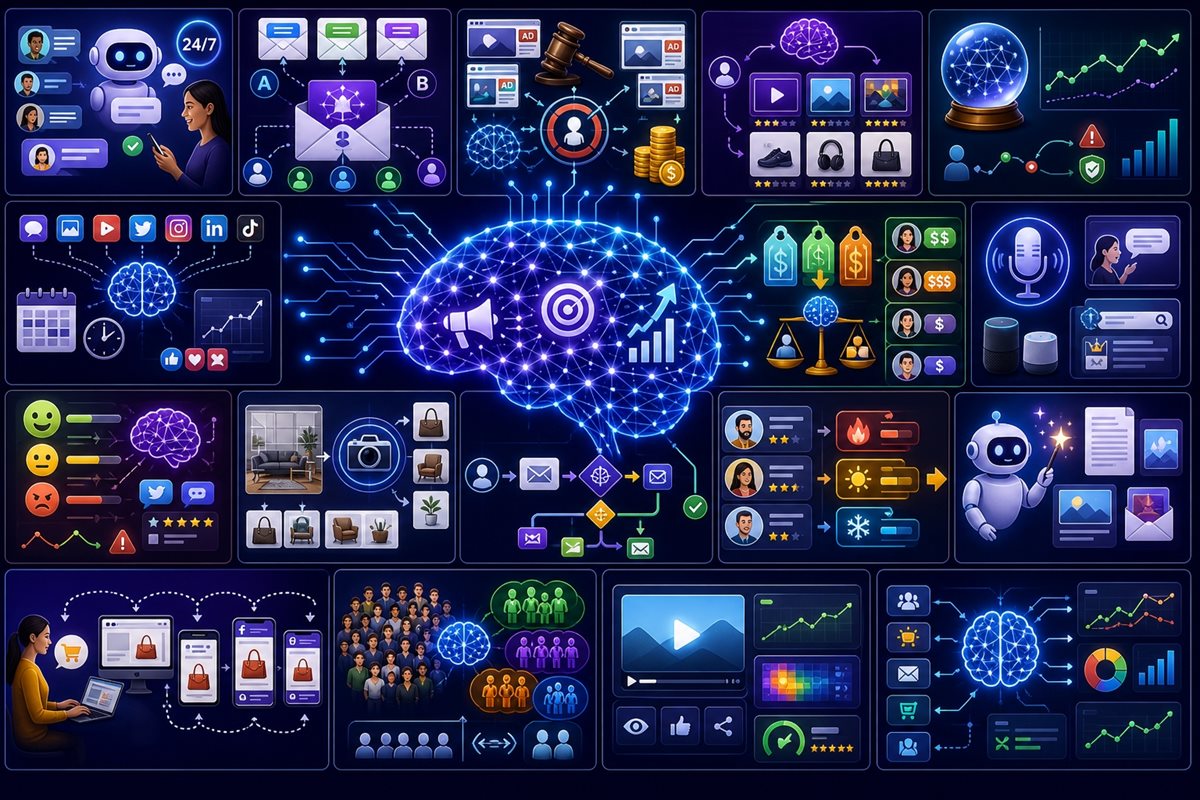
Examples of artificial intelligence in digital marketing include AI writing first drafts, SEO tools optimizing for AI answer engines, Google and Meta automating ad buying, email platforms personalizing sends, recommendation engines like Netflix and Amazon, support chatbots, image and video generators, and predictive analytics. Each automates a task a human used to do by hand.
Here is the fast overview before the detail.
| Marketing area | What AI does | Real example |
|---|---|---|
| Content | Drafts, outlines, optimization | ChatGPT, Jasper, Surfer SEO |
| SEO and search | Optimizes for AI answers, intent | Google AI Overviews, AI keyword tools |
| Paid ads | Automates bidding, targeting, copy | Performance Max, Meta Advantage+ |
| Personalizes content and send time | Klaviyo, Mailchimp | |
| Personalization | Tailors recommendations per user | Amazon, Netflix, Spotify |
| Support | Answers customers in chat | Intercom Fin, custom chatbots |
| Creative | Generates images and video | Midjourney, Adobe Firefly, Descript |
| Analytics | Predicts and explains data | GA4 insights, predictive models |
Want to try one now? Run a real meta description or ad-copy task through an approved AI assistant and compare the draft with your brand standards, evidence, and campaign goal.
Original Evidence: Three Measured Results From My Own Work
Vendor benchmarks tell you what happened across someone else’s customers. The evidence below comes from my own marketing and production work. It is useful because the baseline, observed result, and limitation are stated separately. It is not a promise that another team will get the same outcome.
| Workflow | Baseline | Observed result | What it supports | Important limitation |
|---|---|---|---|---|
| Video production | 5 to 6 hours per video | 10 to 15 minutes with an AI-assisted workflow | Approximately 95% to 97% less hands-on production time | This was my workflow, not a controlled benchmark across creators or video formats |
| Email reactivation | More than 2 million contacts in the campaign audience | 59.1% reported open rate | Owned audience data and relevant targeting can matter more than generating more copy | Open rate is not revenue, and privacy protections can affect open tracking |
| AI subscription audit | An accumulated working stack | 3 overlapping writing tools and 2 forgotten subscriptions identified | Adding tools without replacing a workflow creates cost without proportional value | This identifies duplication, not the quality of every product audited |
For the video result, I converted the old and new workflow times to minutes and calculated (old time - new time) / old time. The conservative comparison is 300 minutes versus 15 minutes, a 95% reduction. The widest comparison is 360 minutes versus 10 minutes, a 97.2% reduction. The honest conclusion is not “AI makes every video 97% faster.” It is that a well-defined production bottleneck can produce a very large, measurable gain.
A Reproducible Test You Can Run
Use this protocol before adding any AI marketing tool to your permanent stack:
- Choose one recurring task and save three representative examples.
- Complete each example with your current process, recording hands-on time and final quality.
- Repeat with the AI-assisted process, including all prompting, checking, and editing time.
- Score both outputs for accuracy, brand fit, evidence, compliance, and publishability on a five-point scale.
- Record tool cost and calculate the monthly value of time saved.
- Keep the tool only if it reduces total time without lowering your minimum quality score.
This separates a fast demo from a repeatable marketing improvement. A tool that drafts in 30 seconds but creates 20 minutes of correction has not saved 20 minutes.
How Is AI Used in Content Marketing?
In content marketing, AI drafts and optimizes text. It generates outlines, first drafts, variations, and summaries, and it scores drafts against what already ranks. The marketer edits for accuracy, voice, and real experience. It speeds up production without replacing the judgment that makes content worth reading.
Example 1: Drafting with ChatGPT and Jasper. These generate outlines, first drafts, and 20 headline options in seconds. I use AI daily for this, but I still add my own anecdotes, data, and honest opinions, because those are the parts readers remember and AI cannot invent.
Example 2: On-page optimization with Surfer SEO or Clearscope. These analyze the top-ranking pages for a keyword and tell you which terms and questions to cover. It turns “write something good” into a concrete checklist.
Example 3: Editing with Grammarly. AI catches grammar, tone, and clarity issues in real time, which raises the floor on every draft your team ships.
The honest limit: AI content sounds average by default. Publish it unedited and it reads like everyone else’s. Use it to scaffold the brief, then make the substance yours.
How Is AI Used in SEO and Search?
In SEO, AI now works on two fronts: the tools that help you optimize, and the search engines themselves. Google AI Overviews answer queries directly using your content, so the goal shifts from ranking links to being cited. AI tools also cluster keywords, classify intent, and map topics far faster than manual research.
Example 4: Google AI Overviews and answer engines. Google, ChatGPT, and Perplexity now answer questions directly and cite sources. Google’s current guidance says its generative search features remain rooted in core Search ranking and quality systems, while unique, non-commodity content is more useful than separate pages for every query variation. That supports a practical approach: publish clear answers, first-hand experience, and facts rather than chasing an “AI ranking” trick. Read Google’s official generative AI search guidance.
Example 5: AI keyword and intent analysis. Instead of eyeballing a spreadsheet, AI can group keywords by meaning and sort them by what the searcher wants: a definition, a comparison, a solution, or a purchase.
For content that earns citations, start with the on-page basics AI has not changed: a precise title, a direct opening answer, descriptive headings, verifiable evidence, and a useful summary.
How Is AI Used in Paid Advertising?
In paid advertising, AI runs the levers humans used to pull: bidding, targeting, placement, and increasingly the creative. You give the platform a goal, a budget, and assets, and it decides who sees what and for how much. It also writes and tests ad copy variations at a scale no human team could match.
Example 6: Google Performance Max and Meta Advantage+. These campaign types hand many operational controls to AI. Google documents that Performance Max uses Google AI for bidding, budget optimization, audiences, creative, and attribution. Meta says Advantage+ leads campaigns apply AI optimization across audience, placements, and campaign budget. You still supply the goal, conversion data, constraints, and creative that determine what the system is optimizing.
Example 7: AI ad copy and creative testing. AI can generate dozens of headline and description variations, while the advertising platform learns which combinations convert. It can also help reviewers surface irrelevant search terms, but a marketer still needs to protect meaning, compliance, and budget.
The trap worth naming: feed the system a bad signal and it will efficiently buy you the wrong outcome, thousands of clicks that never convert. AI does not fix bad measurement, it amplifies it. Set target ROAS and acquisition-cost limits from your real margins before scaling.
How Is AI Used in Email Marketing?
In email marketing, AI personalizes what each subscriber gets and when they get it. It writes subject line options, tailors content blocks by segment, predicts the best send time per person, and flags contacts likely to churn. Done well, it lifts open and click rates without a human writing every version.
Example 8: Send-time and content optimization in Klaviyo and Mailchimp. These predict when each subscriber is most likely to open and adjust content by behavior and purchase history. Mailchimp’s documentation makes an important condition explicit: send-time optimization needs enough historical email data to calculate a recommendation.
I have seen what owned data plus good targeting can do: a reactivation campaign I ran across more than two million contacts hit a 59.1 percent open rate. AI makes producing subject-line variations faster, but the list and the relationship created that result.
The limit: personalization is only as good as your data. Thin or messy data means AI personalizes the wrong message faster.
How Is AI Used for Personalization and Recommendations?
AI personalization tailors what each visitor sees based on their behavior. Recommendation engines predict what a person will want next and surface it automatically. This is the most mature example of AI in marketing, and it drives a large share of engagement and revenue on the platforms that use it well.
Example 9: Recommendation engines at Amazon, Netflix, and Spotify. “Because you watched” and “customers also bought” are AI predicting the next action from patterns across millions of users. McKinsey has long reported that these recommendation systems drive a significant share of what people buy and watch.
Example 10: Dynamic website content. AI swaps headlines, offers, and product suggestions per visitor based on source, location, and past behavior, so two people see two different versions of the same page.
The condition: this needs clean first-party data. Own the audience, adopt a consistent UTM naming convention, and track behavior properly, or the “personalization” is just noise.
How Is AI Used in Customer Service and Chat?
In customer service, AI chatbots and assistants answer common questions instantly, qualify leads, and hand the hard cases to humans. Modern versions trained on your help docs resolve a large share of routine tickets without a person, which frees your team for the conversations that actually need judgment.
Example 11: Support assistants like Intercom Fin and custom chatbots. These read your knowledge base and answer customer questions in natural language, around the clock. For a small business, that is coverage you could not staff otherwise.
The honest limit: a chatbot confidently giving a wrong answer is worse than no answer. Keep a clear path to a human, and check what the bot is actually telling people. AI here is support, not a replacement for accountability.
How Is AI Used for Images and Video?
For creative, AI generates images and edits video from text. It produces ad visuals, social graphics, and product mockups in seconds, and it turns long videos into short clips, adds captions, and edits by editing the transcript. This collapses production time that used to require a designer or an editor.
Example 12: Midjourney, Adobe Firefly, Canva, Descript, and Opus Clip. Midjourney and Firefly generate images from a prompt; Descript edits video like a document; Opus Clip cuts long videos into short-form clips automatically.
This one is personal for me. AI took my video production from five or six hours down to 10 to 15 minutes. That is a real, measurable gain, and it came from automating the middle of the process while I still decided what to make and checked it before it shipped.
The limit: generated visuals can look generic or slightly off, and brand consistency still needs a human eye. Use it to produce options fast, not to publish unchecked.
How Is AI Used in Marketing Analytics?
In analytics, AI speeds up and explains measurement. It surfaces anomalies, predicts outcomes like churn or lifetime value, and answers data questions in plain language. What took an analyst days now takes seconds, which moves marketing from monthly reporting toward continuous, real-time decisions.
Example bonus: predictive analytics and GA4 insights. Platforms now forecast outcomes and surface unusual changes so you can investigate before the next monthly report. Google documents that GA4 anomaly detection uses historical time-series data and credible intervals to flag observed values outside its predicted range. That is evidence of a statistical signal, not proof of the cause. A marketer still has to investigate what changed.
The two hard truths: an AI analyzing broken data gives you a confident, well-written wrong answer, not a warning. And it exposes how unreliable attribution already was rather than fixing it. Build on a few trustworthy signals you control, including revenue, customer lifetime value, acquisition cost, and the ratio between value and cost.
How Can a Small Business Start Using These Examples?
Start with one repetitive, measurable task and add AI to it before touching anything else. Do not buy a stack of overlapping tools. Pick a weekly job (meta descriptions, ad copy, subject lines, social posts), test a free tool on real work, keep human review on anything published or paid, and expand only when it clearly works.
I learned the cost of skipping this the hard way. When I audited my own stack, I found three AI writing tools with overlapping features and a couple of subscriptions I had forgotten I was paying for. Production got cheap, so tools multiplied while results did not. Add AI deliberately, one bottleneck at a time.
Frequently Asked Questions
What is an example of AI in digital marketing?
A clear example is Google Performance Max, where AI automates ad bidding, targeting, and placement from a goal and budget you set. Others include ChatGPT drafting content, Klaviyo personalizing email send times, and Amazon and Netflix recommendation engines predicting what a user wants next.
How is AI used in digital marketing today?
AI is used to generate and optimize content, run programmatic ad campaigns, personalize email and website experiences, power recommendation engines, answer customers through chatbots, create images and video, and analyze data predictively. It automates repetitive tasks while humans keep judgment on strategy and quality.
Is AI in digital marketing free to try?
Yes. Many established AI products offer free tiers or limited trials. Use those plans to test content, ad copy, subject lines, and SEO workflows on representative work before paying for a broader rollout.
Will AI replace digital marketers?
No. AI replaces specific tasks, not marketers. Producing drafts, variations, and reports gets automated, while strategy, customer understanding, and accountability become more valuable. Marketers who direct AI and own the result gain an edge over those who only did manual execution.
What is the most common example of AI in marketing?
Recommendation engines are the most widespread example. Amazon, Netflix, Spotify, and most large ecommerce sites use AI to predict and suggest what each user will want next, driving a large share of engagement and sales.
The Bottom Line
Artificial intelligence in digital marketing is not one thing. It is a set of practical examples across content, SEO, ads, email, personalization, support, creative, and analytics, each automating a task a human used to do by hand. The pattern behind every good example is the same: AI removes a bottleneck, and a human keeps judgment on quality, claims, and strategy.
Do not try to adopt all 12 at once. Pick the one that removes your biggest bottleneck this week, test it on real work, and keep a human on the final call. Not for perfection, but for progress.