 Tool profile
Albert.ai
Autonomous cross-channel media buying that reallocates budget without approval
Albert.ai executes rather than recommends, shifting spend across audiences and channels without waiting for sign-off. The public material does not state which decisions require human approval or how that autonomy is bounded, and no pricing is published.
Visit Albert.aiIs Albert.ai worth it?
- What it is
- Autonomous cross-channel media buying that reallocates budget without approval
- Worth a look if
- You run consistent spend across Google, Meta, YouTube, TikTok and DV360, and the daily labour of reallocating budget is the constraint.
- Skip it if
- You need to approve spend changes before they happen, or you buy on one channel where the platform automation already does this.
- Cost to start
- Not published. Contact required. No. None published.
Albert.ai screenshots
Albert.ai at a glance
| Job category | Media Buying |
|---|---|
| What it replaces | Manual daily budget reallocation across ad platforms |
| Pricing model | Paid only |
| Starting price | Not published. Contact required. |
| Free tier | None published. |
| Getting started | Sales contact required |
| Built for | Advertisers running consistently across Google, Meta, YouTube, TikTok and DV360 |
| Company | Not published |
| Last verified | August 2026 |
Albert.ai pricing and plans
Albert.ai does not publish pricing. Not published. Contact required. None published.
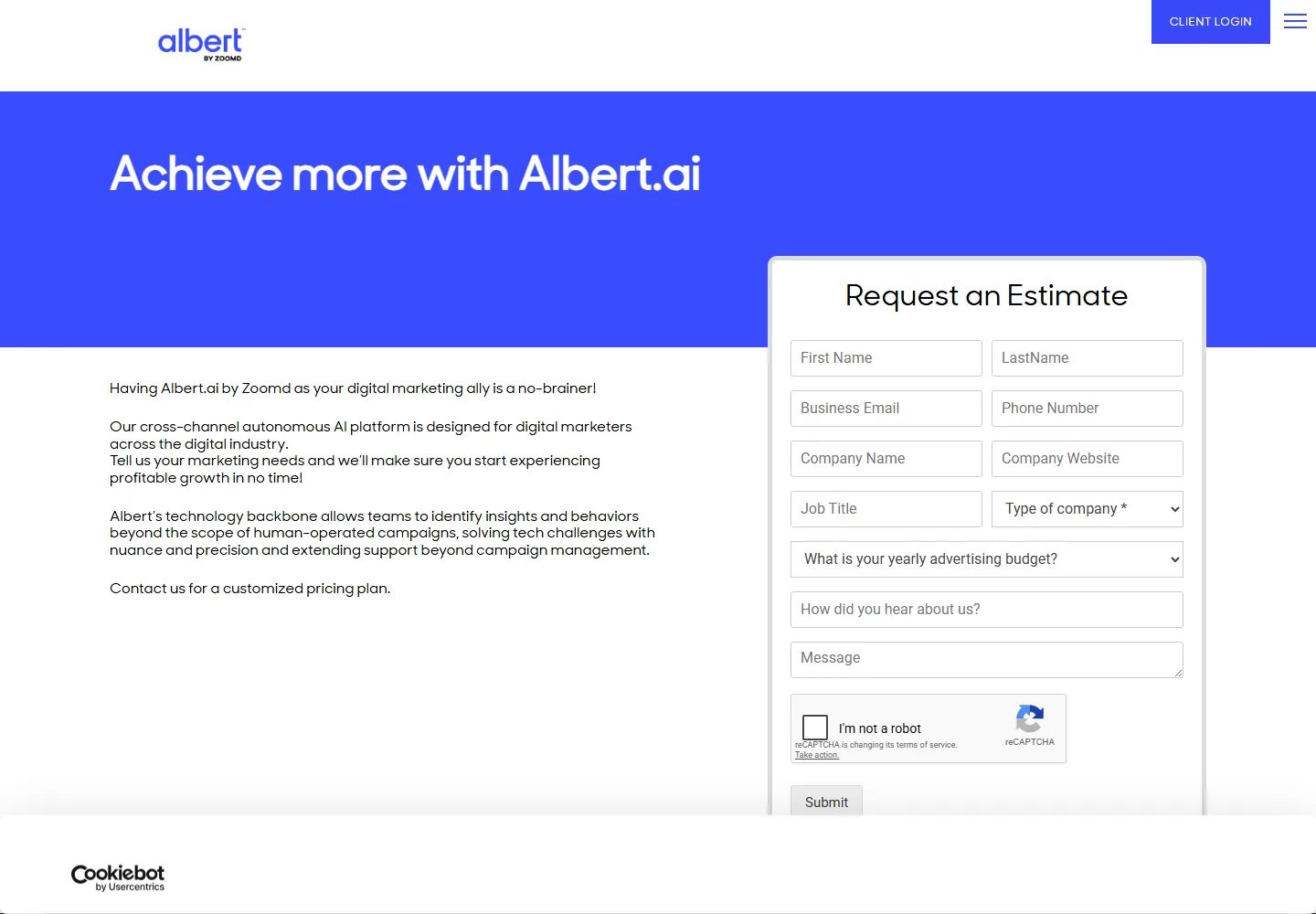
- No prices are published. The pricing page is a Request an Estimate form.
- The form asks for company type and yearly advertising budget range, so the quote is shaped by your spend before any conversation about the product.
No public pricing. For autonomous media tools, establish whether the fee is flat, per account or a share of managed spend, since the last of those aligns vendor revenue with your spending rather than your return.
Albert.ai features: what it does
- Acts rather than recommends, shifting spend across audience segments as performance changes
- Genuine cross-channel scope covering Google, Bing, Meta, YouTube, TikTok and DV360 rather than one platform
- Runs inside your existing ad accounts, so deployment does not require rebuilding campaigns elsewhere
- Implementation described in weeks rather than months, which is realistic for a media buying layer
Albert.ai limitations
- The boundary between autonomous and approved decisions is never stated, which for software that spends money is the central question
- No pricing published, so cost cannot be assessed without a sales process
- Now owned by Zoomd, so roadmap and support sit within a larger group's priorities
- Autonomous optimization inherits your conversion tracking, so a mismeasured event becomes a machine efficiently buying the wrong outcome
Who Albert.ai is for
| Your situation | What that means here |
|---|---|
| Multi-channel advertiser at scale | Genuine cross-channel scope across Google, Bing, Meta, YouTube, TikTok and DV360 rather than one platform. |
| Team drowning in manual reallocation | The product acts rather than recommends, which is exactly the labour it removes. |
| Advertiser who must approve spend changes | The boundary between autonomous and approved decisions is never stated, and that is the central question for software that spends money. |
| Single-channel account | Native platform automation already covers most of this job without another vendor. |
| Enterprise procurement | No published pricing, and ownership by Zoomd puts roadmap and support inside a larger group's priorities. |
| Team willing to define autonomy limits | With explicit guardrails agreed up front, the autonomous model is where the value is. |
Albert.ai use cases for marketers
- Cross-channel paid media buying, shifting budget between audience segments inside your existing ad accounts rather than a rebuilt campaign structure.
Albert.ai FAQ
What can Albert do without asking me?
Not published. Described behaviours include shifting budget between segments, adjusting bids and selecting creative, continuously. Spend ceilings, audience creation and channel additions are not addressed. Get the boundary in writing.
Does autonomy help if my conversion tracking is imperfect?
No, it compounds the error. Automated optimization pursues whatever signal you provide, so a duplicated conversion event gets chased efficiently rather than questioned. Audit tracking before adding autonomy.
How does this compare to Performance Max or Advantage?
The native tools automate inside one platform, sit on auction data no third party sees, and cost nothing. Albert bids across Google, Meta, YouTube, TikTok and DV360, which no single platform will do.
Albert.ai sources and references
- Albert.ai describes an AI marketing platform providing 24/7 optimization that continuously optimizes audience performance and shifts ad spend as audience segment performance changes, tests and selects creative variations automatically, covers what it calls 90 percent of the biddable universe across Google, Bing, Instagram, Facebook, YouTube, TikTok and DV360, deploys inside existing ad accounts and implements in weeks rather than months. Named customers include Crabtree and Evelyn and Interactive Investor, and the company is owned by Zoomd. No pricing is published.albert.ai
- Albert publishes no prices. Its pricing page carries a Request an Estimate form that asks for company type and yearly advertising budget range, and states that pricing is customized.albert.ai
Compiled by Alston Antony from the sources above:how we compile these entries and ouraffiliate disclosure.