 Tool profile
Webflow Optimize
Testing and personalization built into the Webflow CMS, sold as an add-on
Webflow Optimize runs testing and personalization inside the Webflow CMS, so there is no third-party script, no flicker and no separate visual editor. It requires a Webflow site plan plus the add-on, which makes it reachable only for sites already built on Webflow.
Visit Webflow OptimizeIs Webflow Optimize worth it?
- What it is
- Testing and personalization built into the Webflow CMS, sold as an add-on
- Worth a look if
- Your site is already built on Webflow and you want testing with no third-party script, no flicker and no separate editor.
- Skip it if
- You are not on Webflow, since this is a platform add-on, or your traffic is too low for AI allocation to have data to work with.
- Cost to start
- Sold as a paid add-on to an existing Webflow site plan. No. None. Requires a Webflow site plan plus the Optimize add-on.
Webflow Optimize screenshots
Webflow Optimize at a glance
| Job category | CRO and Personalization |
|---|---|
| What it replaces | A third-party testing script bolted onto the site |
| Pricing model | Paid only |
| Starting price | Sold as a paid add-on to an existing Webflow site plan |
| Free tier | None. Requires a Webflow site plan plus the Optimize add-on. |
| Getting started | Paid from day one |
| Built for | Teams already building on Webflow who want testing without a separate platform |
| Company | Not published |
| Last verified | August 2026 |
Webflow Optimize pricing and plans
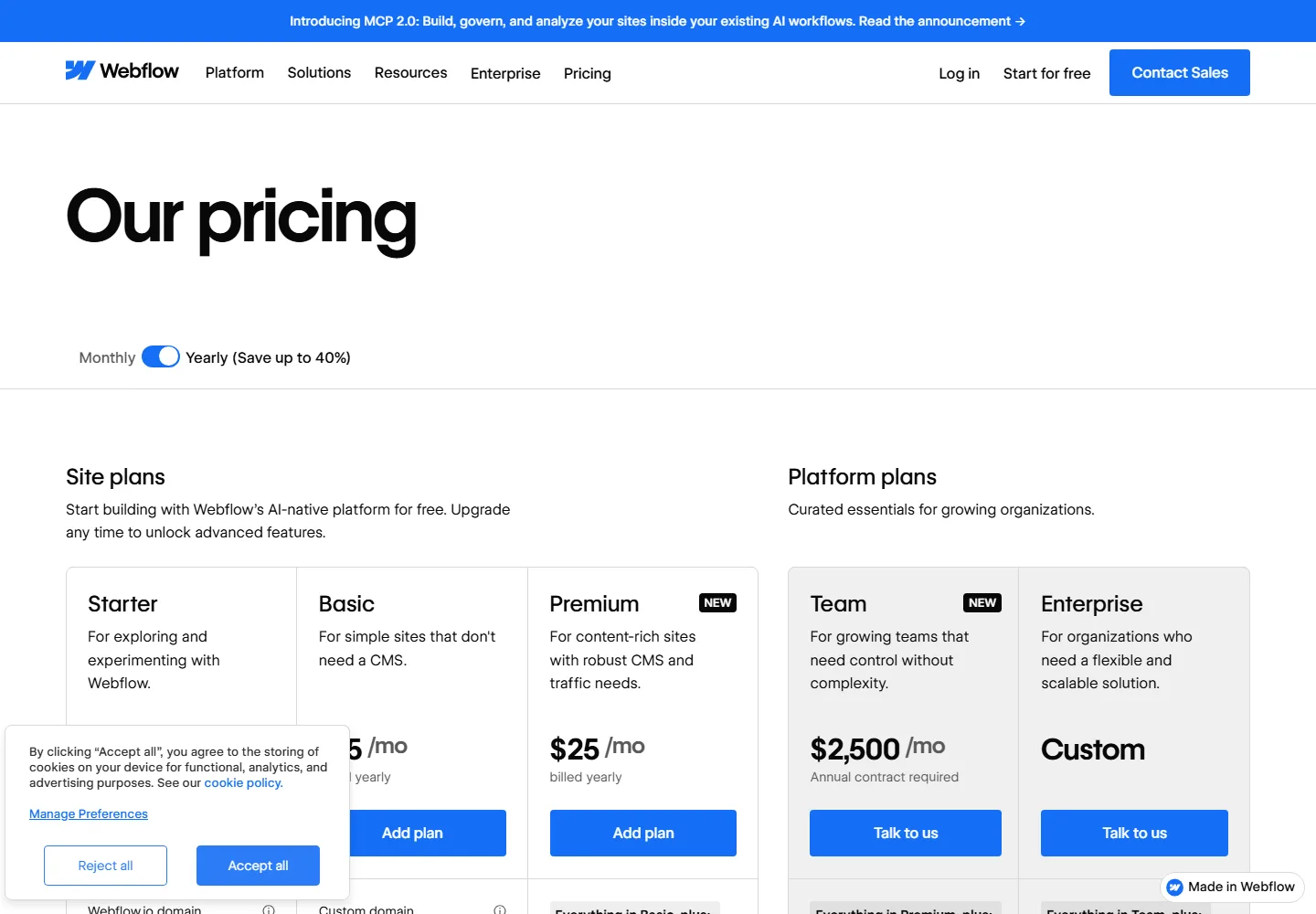
Webflow Optimize does not publish pricing. Sold as a paid add-on to an existing Webflow site plan None. Requires a Webflow site plan plus the Optimize add-on.
- Sold as a paid add-on on top of an existing Webflow site plan, so there is no standalone price and no free tier.
- Access depends on workspace, site plan and purchase of the add-on.
Priced as an add-on rather than standalone, so total cost is the Webflow workspace plan, the site plan and the Optimize add-on together. Assemble all three before comparing.
Webflow Optimize features: what it does
- Native to the CMS, so there is no third-party script, no flicker and no separate editor to fight
- Three distinct modes covering A/B testing, AI traffic allocation and rules-based personalization rather than blurring them
- More than 20 targeting dimensions including industry, company size and estimated revenue, which is unusually firmographic for a website tool
- Marketers can build and launch without developer involvement, which is the practical constraint in most testing programmes
Webflow Optimize limitations
- Sold only as a paid add-on to an existing Webflow site plan, so there is no standalone price and no free tier
- Access depends on workspace, site plan and purchase of the Optimize add-on
- The product page states it works on any CMS while the product is sold as a Webflow add-on, and the two are not reconciled anywhere published. Confirm what a non-Webflow deployment requires before assuming it is available
- Low-traffic sites give the AI allocation too little data to work with, and no minimum traffic guidance is published
- No statistical methodology is published, so what the interface means by a winner cannot be audited
Who Webflow Optimize is for
| Your situation | What that means here |
|---|---|
| Team already on Webflow | Native to the CMS, so no third-party script, no flicker and no separate editor to fight. |
| Team on any other platform | This is a platform add-on rather than a standalone product. |
| Marketer without developer support | Building and launching variants without developer time changes the throughput of a testing programme more than any feature. |
| B2B site using firmographic targeting | Industry, company size and estimated revenue are rarely offered natively in a website builder. |
| Low-traffic site | AI traffic allocation has too little data to work with, and the result is confident allocation on noise. |
| Rigorous experimentation team | No published statistical methodology, and AI allocation changes sampling while the test runs. |
Webflow Optimize use cases for marketers
- Landing page A/B testing and AI traffic allocation run by marketers without developer involvement.
- B2B firmographic personalization across more than 20 dimensions including industry, company size and estimated revenue.
Webflow Optimize FAQ
Why does being native to the CMS matter?
Because it eliminates flicker. A third-party script has to load, decide and repaint, so on a slow connection the visitor sees the original content first. It also removes the separate visual editor that breaks whenever your site changes.
What is the difference between the A/B test and AI optimize modes?
They answer different questions. A/B testing splits traffic evenly and tells you which variant is better. AI optimize shifts traffic toward whatever is winning, which maximizes conversions during the test and makes the final read less clean.
Is firmographic targeting reliable?
Treat it as directional. Industry, company and estimated revenue are inferred from IP and enrichment data, and match rates vary considerably for remote workers, small companies and non-US traffic. Do not build anything that fails badly when the inference is wrong.
Webflow Optimize sources and references
- Webflow Optimize provides A/B tests splitting traffic between variants against a defined goal, AI optimize using machine learning to shift traffic toward the best-performing variant over time, and personalization showing specific content to segments based on attributes such as device, location or referral source, with targeting across more than 20 dimensions including locale, city, country, state, metro area, timezone, time of day, weekday or weekend, industry, company, estimated revenue and employee count. Access depends on workspace, site plan and purchase of the Webflow Optimize add-on.webflow.com
- Webflow describes Optimize on its product page as bringing A/B testing and personalization to your website on any CMS, with AI-driven optimization to maximize conversions.webflow.com
Compiled by Alston Antony from the sources above:how we compile these entries and ouraffiliate disclosure.