 Tool profile
Kameleoon
Enterprise experimentation with ISO 27001, SOC 2 and HIPAA compliance
Kameleoon is an enterprise experimentation platform carrying ISO 27001, SOC 2 and HIPAA compliance, with sample ratio mismatch detection built in. It does not publish the statistical method behind the results it reports, and pricing is quote only.
Visit KameleoonIs Kameleoon worth it?
- What it is
- Enterprise experimentation with ISO 27001, SOC 2 and HIPAA compliance
- Worth a look if
- You need HIPAA, ISO 27001 and SOC 2 alongside experimentation, and 495 USD a month covers 10 experiments and 50,000 tested visitors.
- Skip it if
- Your site lacks the traffic to reach significance on segmented tests, or you want the statistical method documented before purchase.
- Cost to start
- 495 USD a month for up to 10 experiments and 50,000 tested visitors. Trial only. PBX Starter free trial, 30 days with no credit card required.
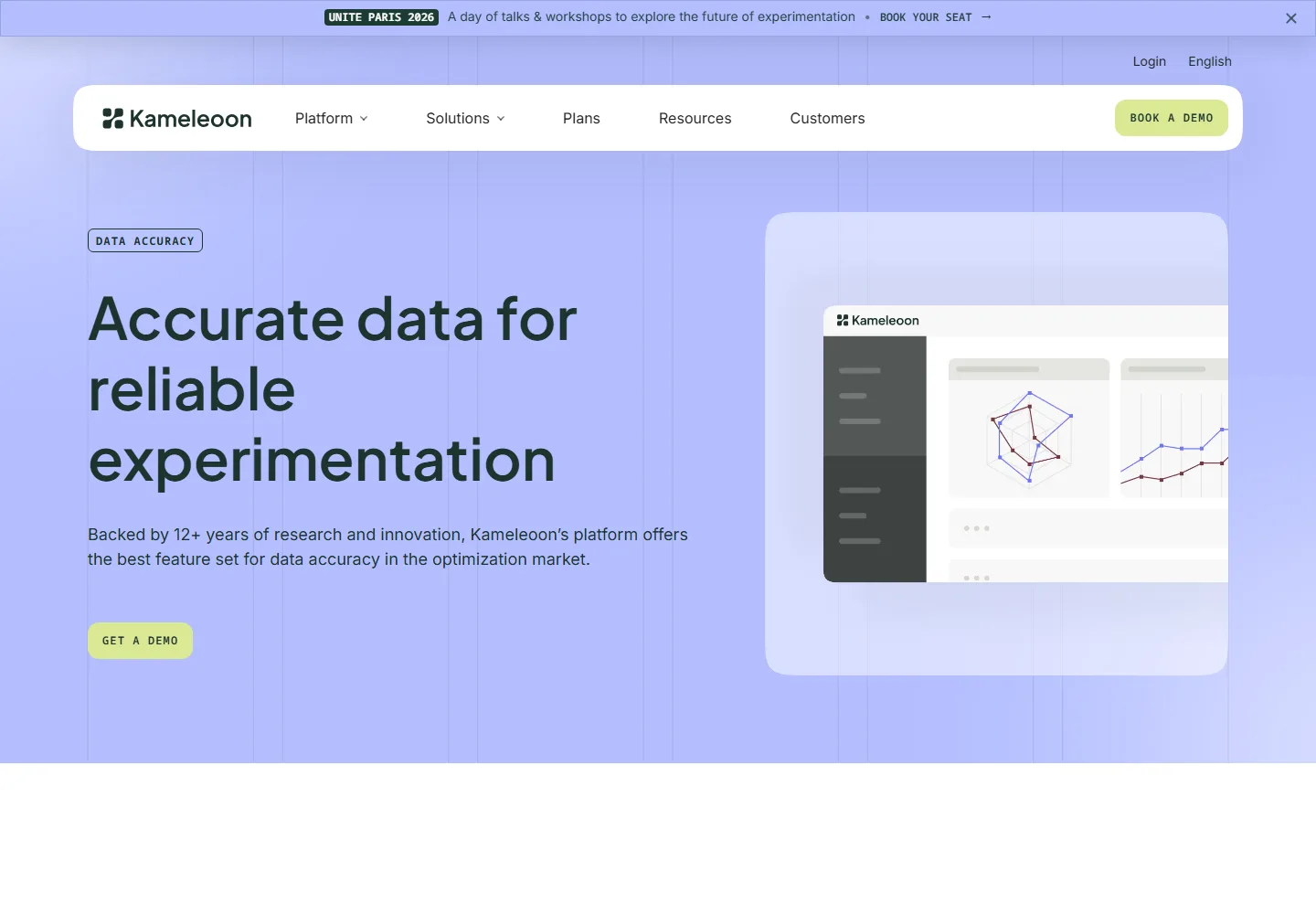
Kameleoon screenshots

Kameleoon at a glance
| Job category | CRO and Personalization |
|---|---|
| What it replaces | Separate web testing, feature flagging and app experimentation tools |
| Pricing model | Trial only |
| Starting price | 495 USD a month for up to 10 experiments and 50,000 tested visitors |
| Free tier | PBX Starter free trial, 30 days with no credit card required. |
| Getting started | Free trial |
| Built for | Regulated industries needing HIPAA, ISO 27001 and SOC 2 alongside experimentation |
| Company | Not published |
| Last verified | August 2026 |
Kameleoon pricing and plans
| Plan | Price | What it includes | What that works out at |
|---|---|---|---|
| PBX Starter | Free | 30 day trial, no credit card required | |
| Published tier | 495 USD a month | Up to 10 experiments and 50,000 tested visitors a month, with 30, 100 or 200 AI credits depending on plan | About 0.0099 USD per tested visitor at the 50,000 ceiling, or 49.50 USD per experiment if all 10 are used. |
| Custom | Quoted on request | Assembled from the modules a team needs, with EU, US or custom data residency and optional on-premise self-hosting of the script |
- The published tier is 495 USD a month and caps both experiments and traffic, at 10 experiments and 50,000 tested visitors.
- Exceeding either cap moves you to a custom quote, so the published price is a floor rather than a range.
- The free trial is 30 days with no credit card, which is unusually long for this category.
- AI credits are separately allocated at 30, 100 or 200 a month depending on plan.
- Data residency is selectable as EU, US or custom, and the script can be self-hosted on-premise.
No public pricing. Expect enterprise contracting, and confirm whether traffic volume, seats or feature modules drive the number.
Kameleoon features: what it does
- Sample ratio mismatch detection is built in, which catches a common and easily missed source of invalid test results
- Compliance coverage is unusually strong, with ISO 27001, SOC 2, GDPR, CCPA and HIPAA all stated
- Spans A/B testing, feature flagging, mobile app testing and product recommendations rather than web testing alone
- Contextual bandit testing is offered alongside classical tests, which suits optimization where traffic allocation matters more than a clean read
Kameleoon limitations
- No statistical methodology published, so whether results are frequentist, Bayesian or sequential is unknown before purchase
- No pricing published, requiring a sales process to establish affordability
- Predictive Impact Scoring is described as built on data from thousands of experiments without stating how that transfers to your context
- Prompt-based experimentation lowers the cost of launching tests, which raises the risk of running more underpowered ones
Who Kameleoon is for
| Your situation | What that means here |
|---|---|
| Regulated industry team | HIPAA, ISO 27001, SOC 2, GDPR and CCPA all stated, which is unusually complete for this category. |
| Enterprise running web, app and feature flags | One platform across all three rather than separate tools with separate integrations. |
| Statistically demanding practitioner | No statistical methodology published, so frequentist, Bayesian or sequential is unknown before purchase. |
| Small site | Without traffic to reach significance, segmented testing produces confident noise. |
| Experimentation programme lead | Built-in sample ratio mismatch detection catches a common and easily missed source of invalid results. |
| Buyer shortlisting on price | Quote only, so affordability requires a sales process. |
Kameleoon use cases for marketers
- Landing page and funnel experimentation in regulated industries, where the compliance coverage is the gating factor.
- Conversion optimization using contextual bandits where traffic allocation matters more than a clean read, with sample ratio mismatch detection built in.
Kameleoon FAQ
Why does the statistical method matter if the platform reports a winner?
Because the method determines what winner means. A fixed-sample frequentist test, a Bayesian model and a sequential test call different results at different times on the same data. Peeking at a fixed-sample test daily raises your false positive rate.
What is sample ratio mismatch, and why does built-in detection matter?
SRM is traffic not splitting as intended, say 52 to 48 instead of 50 to 50. It usually indicates a bug in assignment or tracking and silently invalidates the result. Most teams never check for it.
Does making experiments easier to launch improve results?
Only if launching them was the constraint. Lower cost per test means more tests, which on thin traffic means more underpowered tests producing confident nonsense. Throughput without power discipline makes an organization more confident and no better informed.
Kameleoon sources and references
- Kameleoon describes an AI-powered experimentation platform with Prompt-Based Experimentation, A/B testing, feature flagging, AI personalization, contextual bandit testing, mobile app testing, product recommendations, Predictive Impact Scoring built on data from thousands of experiments, and sample ratio mismatch detection. It states ISO 27001 and SOC 2 certification and GDPR, CCPA and HIPAA compliance, and names Samsung, Toyota, Fossil, Best Western, Canada Goose and Lidl among customers. No pricing and no statistical methodology are published.kameleoon.com
- Kameleoon publishes plans at kameleoon.com/plans: a PBX Starter free trial lasting 30 days with no credit card required, a tier at 495 USD a month covering up to 10 experiments and 50,000 tested visitors a month, and a custom tier. AI credits are allocated at 30, 100 or 200 a month depending on plan, data residency is offered as EU, US or custom, and self-hosting the Kameleoon script is available as an on-premise setup.kameleoon.com
Compiled by Alston Antony from the sources above:how we compile these entries and ouraffiliate disclosure.