 Tool profile
Blueshift
Customer data platform and engagement in one, now part of BlueConic
Blueshift combines a customer data platform with cross-channel execution in one product, which removes the integration seam between segmentation and delivery. It has been acquired by BlueConic, so roadmap and product continuity are open questions. Pricing is contact-sales only.
Visit BlueshiftIs Blueshift worth it?
- What it is
- Customer data platform and engagement in one, now part of BlueConic
- Worth a look if
- Your B2C customer data sits apart from your messaging tools and you intend to replace both with one product.
- Skip it if
- You already run a separate CDP, or you do B2B lifecycle marketing, which the consumer data model does not fit.
- Cost to start
- From 1,250 USD a month for Starter, billed annually. No. None published.
Blueshift screenshots
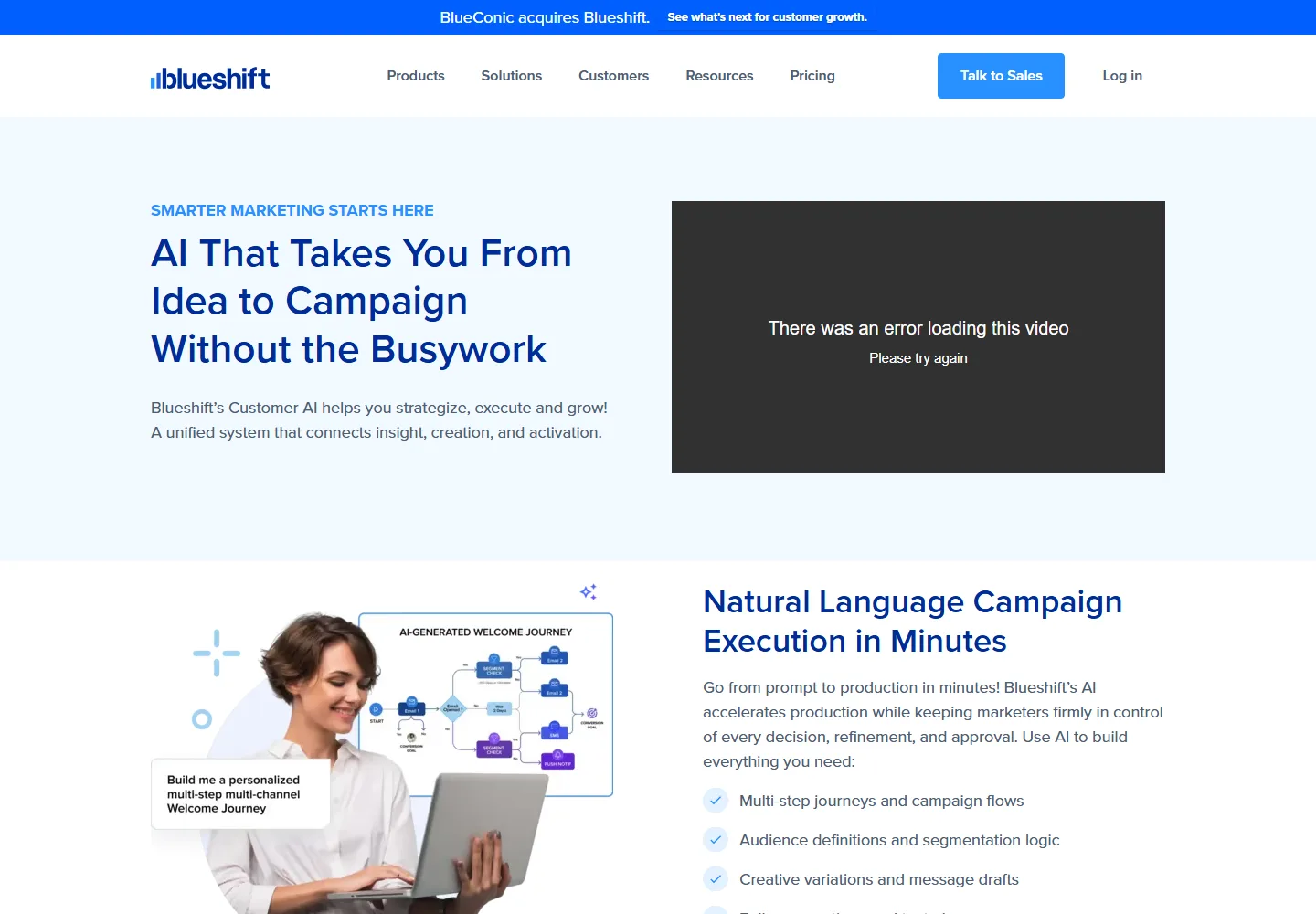
Blueshift at a glance
| Job category | Automation and Lifecycle |
|---|---|
| What it replaces | A separate CDP wired to a separate engagement platform |
| Pricing model | Paid only |
| Starting price | From 1,250 USD a month for Starter, billed annually |
| Free tier | None published. |
| Getting started | Paid from day one |
| Built for | B2C businesses whose customer data currently sits apart from their messaging tools |
| Company | Acquired by BlueConic. No legal entity or registered address published. |
| Last verified | August 2026 |
Blueshift pricing and plans
Blueshift does not publish pricing. From 1,250 USD a month for Starter, billed annually None published.
- Starter starts at 1,250 USD a month and is billed annually, so the smallest published commitment is 15,000 USD a year.
- Growth and Enterprise carry no figure, so only the entry tier can be costed without a sales process.
No public pricing. Confirm whether cost scales with customer profiles, message volume or both, and ask how the BlueConic acquisition affects renewal terms.
Blueshift features: what it does
- CDP and engagement in one product removes the sync-and-reconcile problem that undermines separate stacks
- Predictive scoring for purchase likelihood and churn risk is applied within journeys rather than exported to a dashboard
- Real-time audience building without IT involvement, which is the practical constraint in most lifecycle teams
- Broad channel coverage including email, SMS, push, in-app, paid media, website content and WhatsApp
Blueshift limitations
- Recently acquired by BlueConic, so roadmap, pricing and support arrangements may change during your contract term
- Buying a combined CDP and engagement product duplicates spend if you already run a separate CDP
- Published outcomes such as 181 percent email revenue growth are uncontrolled customer accounts rather than measured lift
- No pricing published, requiring a sales process to establish cost
Who Blueshift is for
| Your situation | What that means here |
|---|---|
| B2C brand with data split from messaging | CDP and engagement in one product removes the sync-and-reconcile problem that undermines separate stacks. |
| Company already running a CDP | You would duplicate the most expensive part of the stack for overlapping capability. |
| Lifecycle marketer without engineering support | Real-time audience building without IT involvement is the practical constraint in most lifecycle teams. |
| B2B lifecycle team | The product is shaped for consumer patterns, and B2B relationships do not map onto them cleanly. |
| Buyer needing roadmap certainty | Recently acquired by BlueConic, so roadmap, pricing and support may change mid-contract. |
| Team wanting predictions inside journeys | Churn risk and purchase likelihood applied within journeys rather than exported to a dashboard. |
Blueshift use cases for marketers
- Lifecycle email, SMS, push and WhatsApp journeys built from live behavioural segments without an engineering ticket per audience.
- Churn and purchase-likelihood scoring applied inside a journey rather than exported to a dashboard.
Blueshift performance claims, checked
Blueshift publishes a 181 percent increase in email revenue within a year and 60-plus hours a month saved in marketing operations. Both are customer accounts rather than measured lift: neither states a control group, a time window, or what else changed in the same period. Teams that adopt a new platform typically rebuild segmentation and refresh creative at the same time, and either would move the same number.
Blueshift FAQ
How should the BlueConic acquisition affect my decision?
It adds three questions rather than a no: whether the Blueshift roadmap continues or converges, whether pricing changes at renewal, and what support looks like in twelve months.
Blueshift sources and references
- Blueshift describes an AI-powered customer engagement platform combining a CDP that unifies behavioural, transactional and identity data, campaign journeys, real-time audience segmentation without IT support, and cross-channel execution across email, SMS and MMS, push, in-app, paid media, website content and WhatsApp. It describes predictive AI scoring for purchase likelihood and churn risk, generative AI for content, and agentic AI executing multi-step tasks with marketer oversight. Named customers include BBC, CarParts.com, Five Below, LendingTree and Sweetwater, and the site notes BlueConic has acquired Blueshift. No pricing is published.blueshift.com
- Blueshift publishes a Starter tier at plans starting from 1,250 USD a month billed annually. Growth and Enterprise carry no published figure and direct buyers to sales.blueshift.com
Compiled by Alston Antony from the sources above:how we compile these entries and ouraffiliate disclosure.