 Tool profile
AthenaHQ
AI search visibility tracking with a fully published price list
AthenaHQ tracks brand visibility in AI search and publishes its full price list, which most of this category does not. One credit equals one AI response, so the cost of a tracking programme can be calculated before purchase rather than after a sales call.
Visit AthenaHQIs AthenaHQ worth it?
- What it is
- AI search visibility tracking with a fully published price list
- Worth a look if
- You need a published price to benchmark GEO quotes against, and unlimited seats on every tier including the free 300-credit plan.
- Skip it if
- You track many brands, where credit consumption multiplies, or you need API access on the entry paid plan rather than as a billed add-on.
- Cost to start
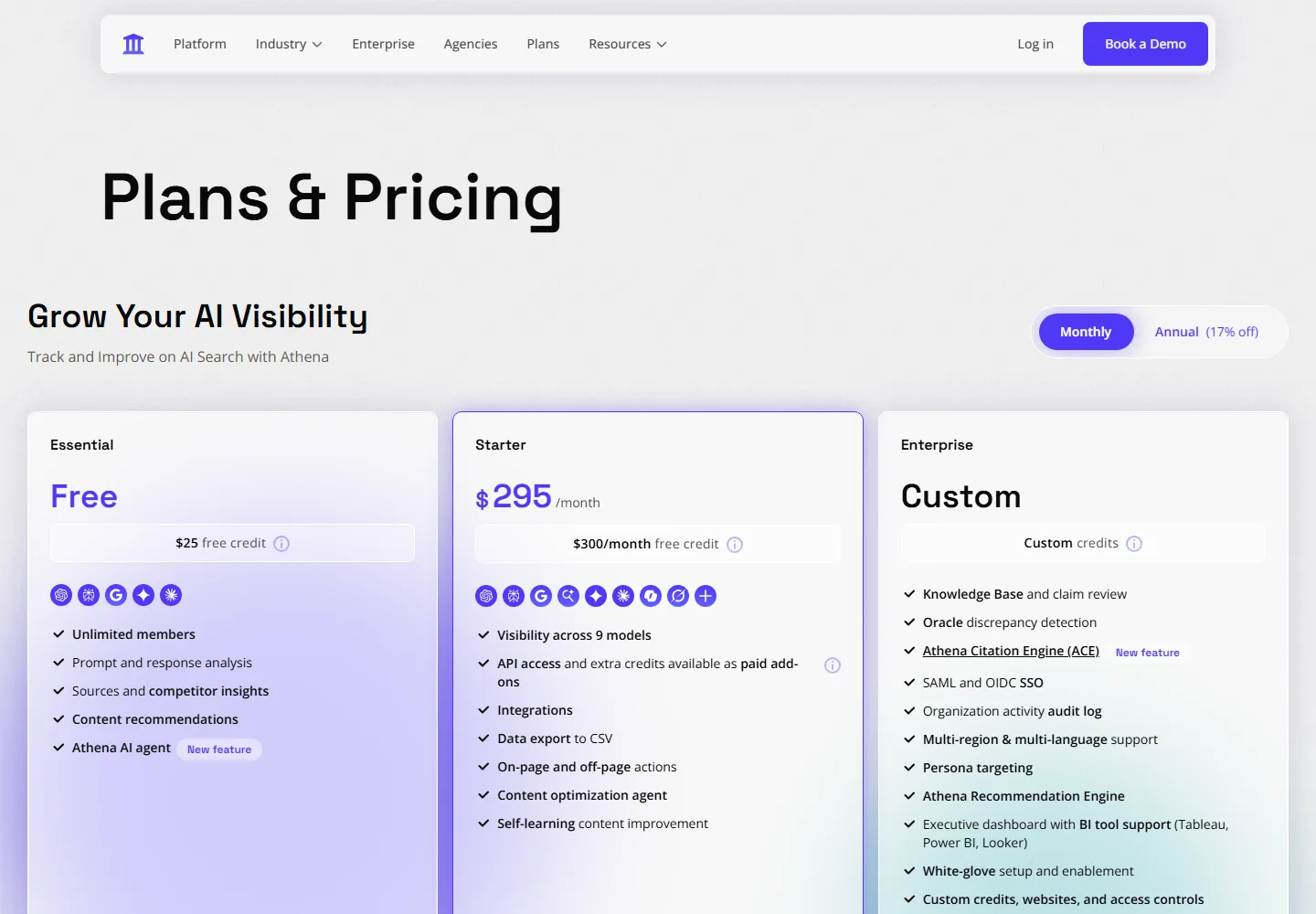
- 295 USD per month for Starter, with a 17 percent annual discount. Yes. Essential plan with 300 credits and 5 AI platforms, unlimited seats.
AthenaHQ screenshots
AthenaHQ at a glance
| Job category | AI Search and GEO |
|---|---|
| What it replaces | Manually prompting AI engines to see whether your brand comes up |
| Pricing model | Free tier |
| Starting price | 295 USD per month for Starter, with a 17 percent annual discount |
| Free tier | Essential plan with 300 credits and 5 AI platforms, unlimited seats. |
| Getting started | Free tier |
| Built for | Teams that need to justify a GEO budget with a number before committing |
| Company | Not published |
| Last verified | August 2026 |
AthenaHQ pricing and plans
AthenaHQ does not publish pricing. 295 USD per month for Starter, with a 17 percent annual discount Essential plan with 300 credits and 5 AI platforms, unlimited seats.
- Starter is 295 USD a month with a 17 percent annual discount.
- The Essential free plan carries 300 credits across 5 AI platforms with unlimited seats.
- API access is a separately billed add-on rather than included on the entry paid plan.
Billed in credits where one credit equals one AI response. Multiply prompts by engines by refresh frequency to estimate consumption. API access is a paid add-on on Starter.
AthenaHQ features: what it does
- Pricing is fully published, from a free tier to a 295 dollar Starter plan, which is close to unique in this category
- One credit equals one AI response, so cost can be calculated from prompts times engines times refresh frequency
- Unlimited seats on every tier including the free plan, so the tool does not tax collaboration
- A genuinely usable free tier with 300 credits across 5 engines, enough to test the premise before paying
- Covers 9 engines on paid plans including AI Mode, Copilot and Grok alongside the obvious ones
AthenaHQ limitations
- API access on the Starter plan is a paid add-on billed separately, so the 295 dollar figure is a floor rather than a total
- Credits are consumed per response, so tracking many prompts across many engines daily exhausts an allowance faster than the headline number suggests
- Optimization recommendations rest on correlation, as everything in this category currently does, and the marketing does not foreground that
- The published case study figures are vendor-supplied and not independently verifiable
Who AthenaHQ is for
| Your situation | What that means here |
|---|---|
| In-house marketer building a GEO case | The published price list is the whole point. You can put a real number in a budget request without booking a call. |
| Agency managing many brands | Credits are consumed per AI response, so tracking several brands multiplies consumption faster than the headline plan suggests. |
| Developer wanting API access | API access on Starter is a separately billed add-on, so the 295 dollar figure is a floor rather than a total. |
| Large team needing many seats | Unlimited seats on every tier including the free plan, so collaboration is not taxed per head. |
| Enterprise procurement | Transparent pricing helps, but nothing published covers SSO, audit logs or contractual support terms. |
| Buyer wanting proof recommendations work | Optimization advice rests on correlation, and the marketing does not foreground that limitation. |
AthenaHQ use cases for marketers
- AI search visibility reporting, where one credit equals one AI response so the monthly cost is prompts times engines times refresh frequency.
- Brand monitoring across 9 engines on paid plans, including AI Mode, Copilot and Grok.
AthenaHQ FAQ
How many prompts can 3,600 credits actually track?
Twenty prompts across 9 engines once a day consumes 180 credits daily and exhausts 3,600 in 20 days. The same 20 prompts weekly costs about 720 a month. Decide refresh frequency first.
AthenaHQ sources and references
- AthenaHQ publishes an Essential free tier with a 25 dollar credit equal to 300 credits and 5 AI platforms; a Starter plan at 295 USD per month with 3,600 monthly credits where one credit equals one AI response, 9 AI platforms, unlimited seats and API access as a paid add-on; and a custom-priced Enterprise tier adding SSO, audit logs, multi-region support and BI integration. An annual discount of 17 percent is offered.athenahq.ai
- AthenaHQ describes cross-platform AI visibility tracking across ChatGPT, Perplexity, Google AI Overviews, Google AI Mode, Gemini, Claude, Copilot and Grok, with citation source analysis, brand mention and sentiment monitoring, and content gap identification. The company states it is Y Combinator backed.athenahq.ai
Compiled by Alston Antony from the sources above:how we compile these entries and ouraffiliate disclosure.